The Doctor You Will Never Forget: Understanding the Human Operating System in Clinical Medicine
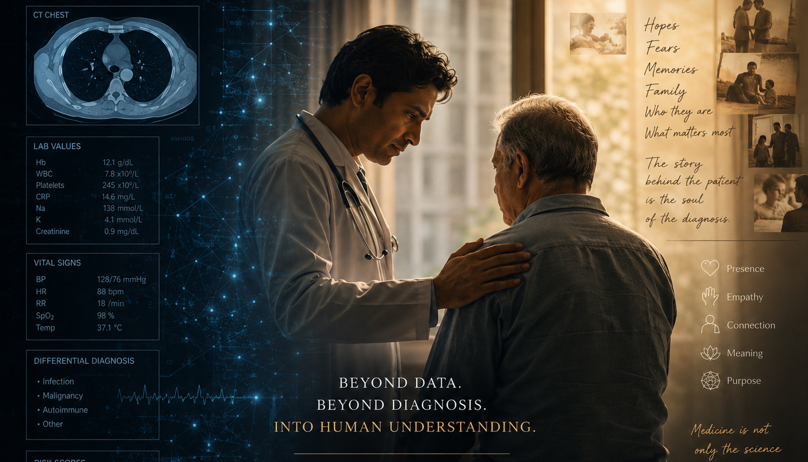
A machine can be right about a patient without understanding them. This is not a criticism of machines. It is a precise...
A practicing internist's essays on clinical reasoning, the philosophy of diagnosis, AI in medicine, and the enduring humanity of the doctor–patient relationship.
Every essay belongs to a pillar — a disciplined way of thinking about a dimension of medicine.
Bedside medical philosophy. The original discipline Dr. Shinde coined to name what happens when a physician stops and asks: Why do we think the way we think?
How a physician arrives at a diagnosis is not instinct — it is a discipline. Essays on the logic, bias, and beauty of clinical thought.
A diagnosis is a hypothesis. These essays examine what we know, what we assume, and what we deliberately leave open.
What artificial intelligence can do, what it cannot, and what it may never understand about the clinical encounter. Written from inside the consultation room.
The doctor–patient relationship as an ethical act. Essays on trust, presence, communication, and the irreducible humanity of care.
First-person accounts from the wards and the clinic — on uncertainty, error, grief, and what it means to carry another person's illness.
Where clinical philosophy meets the real world — systems, access, incentives, and the gap between what medicine promises and what it delivers.
Illuminating concepts patients encounter but rarely understand — written for the thinking person who wants to be an informed participant in their own care.
Essays that have reached the most readers — each one a place to begin thinking.
Guided reading routes through the content — structured for physicians re-examining their practice, for medical students building a philosophical foundation, and for curious readers who want depth over breadth.
A visual index of the concepts, arguments, and intellectual references that run through every essay — from Hickam\'s Dictum to Wittgenstein\'s limits to the Turing Paradox. The thinking behind the thinking.
A growing glossary of terms coined or reframed in these essays — Medisophy, Belief Stabilization Threshold, the Trilogy of Clinical Wisdom. Definitions that belong to the site, not to a textbook.
I am a practicing internist who writes about medicine the way it is actually practised — inside the uncertainty, within the relationship, at the edge of what is known.
These essays explore the philosophy, ethics, and reasoning that govern clinical decisions. They are not clinical guidelines. They are attempts to think clearly about what medicine is and what it demands of both physician and patient.
Medisophy — the philosophy of medicine at the bedside — is the category I coined to name this space. This site is its canonical home.