
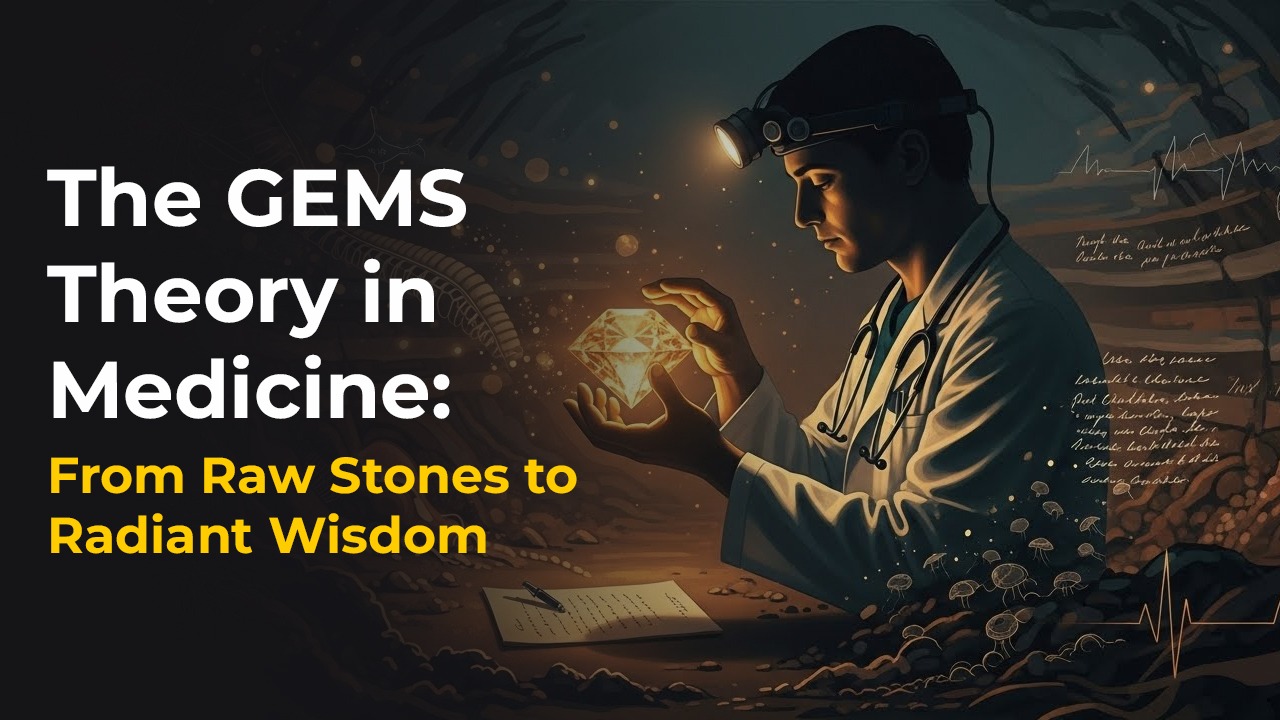
Medicine has always lived in metaphors. We speak of “clinical pearls”, “gold standards”, and “silver linings”. But what if we thought of our work not just as applying science but as discovering and polishing gems?
The GEMS Theory in Medicine is a framework that reminds us that clinical practice is not about mechanical steps but about transforming raw experience into refined wisdom. Much like a gem that is mined, cut, set, and admired, medical knowledge and healing undergo stages of gathering, evaluating, managing, and synthesising.
1. G – Gather: The Mining of Medicine
Every gem lies hidden in the earth, waiting for the careful miner. Similarly, every diagnosis lies hidden in the patient’s narrative.
- In practice: Gathering is the painstaking work of history-taking, attentive listening, and nuanced observation. It is noticing the tremor in a hand, the hesitation in a voice, and the shadow of grief in a story.
- The challenge: Too often, physicians rush to conclusions, digging only superficially. Like miners ignoring deeper veins, we miss the hidden gems.
- The insight: The richest gems of diagnosis often emerge not from advanced technology but from the patient’s lived experience, offered freely if we are present enough to hear it.
Gathering requires humility—to accept that the raw material of wisdom does not belong to the physician but comes from the patient.
2. E. Evaluate: The Cutting of Knowledge
Once mined, a stone is still rough, dull, and unformed. Its potential shines only when carefully cut. In medicine, this stage is clinical reasoning—evaluating evidence, testing hypotheses, and distinguishing truth from illusion.
- In practice: Evaluating means interpreting investigations, weighing probabilities, and checking for biases. A chest pain might be cardiac, musculoskeletal, or psychogenic—the gem cutter must choose angles wisely.
- The challenge: Confirmation bias, anchoring, and over-reliance on technology may cloud the stone rather than reveal its brilliance.
- The insight: evaluation requires both science and craft. Just as a gem’s cut determines its sparkle, a physician’s reasoning determines whether the truth of illness emerges clearly or remains obscured.
Evaluation demands scepticism—a willingness to test, doubt, and refine until clarity emerges.
3. M – Manage: The Setting of Healing
A gem, once cut, must be set into a design. A brilliant diamond in a poor setting loses its meaning. So too with medicine: a perfect diagnosis is useless if not translated into an effective, patient-centred management plan.
- In practice: management includes prescribing drugs, advising lifestyle changes, performing procedures, or sometimes choosing not to intervene.
- The challenge: A technically correct plan may fail if it ignores context—financial barriers, cultural beliefs, and emotional readiness.
- The insight: Just as a jeweller chooses a setting that fits both stone and wearer, physicians must choose treatments that fit the disease and the patient’s life.
Management is where medicine becomes moral—where science meets human responsibility.
4. S – Synthesise: The Sharing of Light
The true purpose of a gem is to shine. The true purpose of medical knowledge is not possession but illumination. Synthesis means integrating diagnosis and treatment into a story that both patient and physician can carry forward.
- In practice: Explaining the illness, clarifying uncertainties, offering reassurance, and planning together.
- The challenge: Without synthesis, patients feel lost in fragments—test results without meaning, treatments without narrative.
- The insight: When physicians synthesise well, the patient not only understands but also feels seen, valued, and empowered. The gem of wisdom shines beyond the clinic, guiding the patient’s life.
Synthesis transforms knowledge into wisdom—not just for the physician, but for the patient, family, and community.
Why GEMS Theory Matters in Medicine
The GEMS framework is more than a memory tool. It is a philosophy of practice:
- It reminds us that data is not enough—we must refine it.
- It highlights that management without meaning is hollow.
- It teaches that true healing is shared light, not hoarded expertise.
In a medical culture obsessed with speed, metrics, and guidelines, GEMS asks us to slow down and remember that we are not merely technicians but craftsmen of human meaning.
The Thinking Healer’s Reflection
In every clinical encounter lies a potential gem. Sometimes it is small, like the quiet relief of a patient reassured. Sometimes it is priceless, like the insight that changes a diagnosis—and a life.
But gems do not polish themselves. They require patient mining, careful cutting, thoughtful setting, and generous sharing.
Perhaps the greatest test of a physician is not how many gems they collect, but how much light they help to spread.
Medicine, after all, is less about owning knowledge and more about turning the hidden into the radiant.






Dr Ashvin Bhatt
Awesome….