
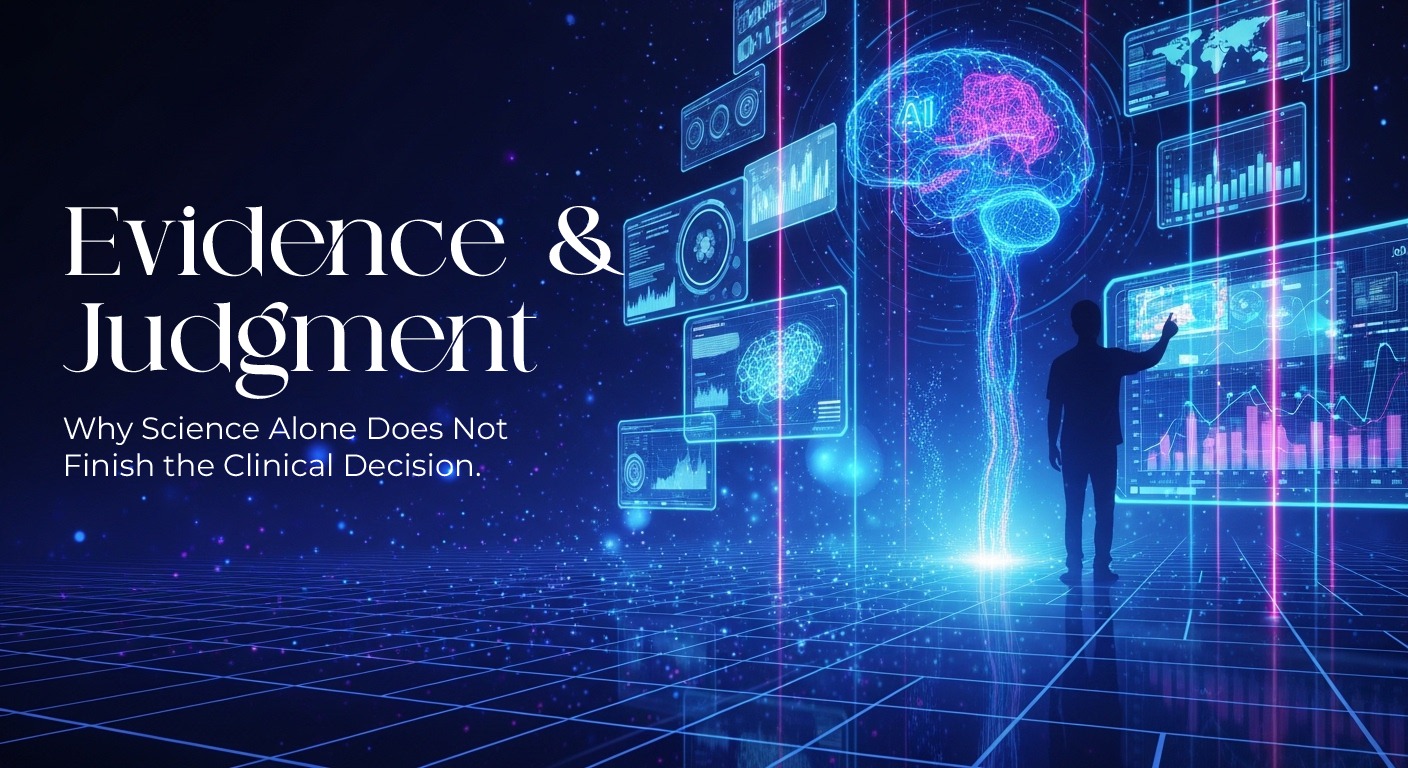
A Familiar Dilemma
CLINICAL SCENARIO
A 72-year-old man is brought to the outpatient clinic with progressive breathlessness over three weeks. He has a history of ischaemic heart disease, stage 3 chronic kidney disease, and type 2 diabetes. His current medications include three antihypertensives, a statin, antiplatelet therapy, and insulin.
Echocardiography reveals reduced ejection fraction. Evidence-based guidelines clearly recommend initiating an ACE inhibitor and a beta-blocker. The evidence for these agents in heart failure is unambiguous — drawn from landmark randomised trials involving tens of thousands of patients.
But the patient’s creatinine is already elevated. He lives alone, is reluctant to add more medications, and asks whether he might manage with lifestyle changes alone. His daughter, present at the consultation, is worried about pill burden and side effects.
The guideline says one thing. The patient sitting before you says another. At this moment, evidence alone cannot finish the decision. This is where clinical judgment begins.
I. The Promise of Scientific Medicine
Modern medicine is built upon science. Over the past century, clinical practice has increasingly relied on controlled trials, epidemiology, statistical analysis, and systematic reviews to guide decisions. This movement — Evidence-Based Medicine — emerged to ensure that treatments are grounded in reliable scientific data rather than tradition, habit, or authority.
The transformation has been profound. Many therapies once widely accepted were later shown, through rigorous research, to be ineffective or actively harmful. Scientific evaluation replaced anecdote with measurable evidence. From antibiotics to cardiovascular drugs, the achievements of this era are undeniable.
“ FOUNDATIONAL DEFINITION · SACKETT ET AL., 1996
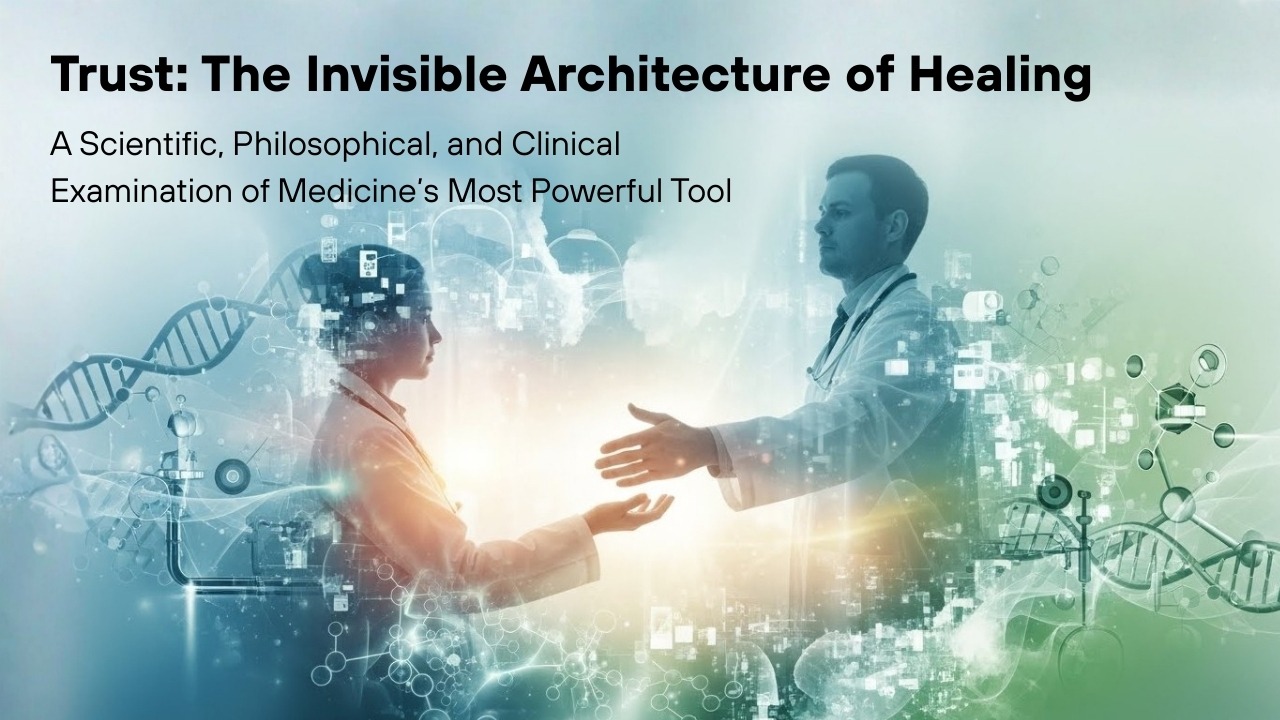
Evidence-Based Medicine was defined by Sackett and colleagues as “the conscientious, explicit, and judicious use of current best evidence in making decisions about the care of individual patients.” Crucially, this definition already anticipated the problem: best evidence must be integrated with individual clinical expertise and patient values — it was never intended to replace them.
Yet despite these advances, a deeper question remains: Is scientific evidence alone sufficient to make clinical decisions? The answer, revealed through both philosophical reflection and empirical research, is no.
II. What Evidence Actually Provides
Scientific evidence answers an important but limited question: What tends to work on average? Randomised trials compare treatments across groups of patients. Statistical methods estimate probabilities of benefit or harm. Systematic reviews synthesise multiple studies to strengthen and generalise conclusions.
These methods are powerful precisely because they control for bias and reduce the influence of individual impressions. In this sense, evidence acts as medicine’s most reliable corrective against error — a disciplining force on clinical intuition.
Scientific studies describe populations, not individuals. Evidence, by its nature, provides general knowledge. The clinical decision must still be made at the bedside.
Every clinical trial involves inclusion and exclusion criteria, controlled settings, and standardised protocols. Real patients routinely differ from study participants:
- Multiple coexisting diseases not represented in trial populations
- Advanced age or frailty that trial designs deliberately exclude
- Polypharmacy with interactions unexplored by the original studies
- Personal values, preferences, and life circumstances that algorithms cannot encod
- Social and contextual factors — literacy, support, access — that shape adherence
The patient in the opening vignette illustrates each of these divergences simultaneously. The gap between the research population and the individual patient is not an exception — it is the rule.
III. The Gap Between Research and Reality
Clinical trials prioritise internal validity — they are designed to isolate causal relationships as clearly as possible by controlling confounding variables. But this very precision often reduces external validity: the degree to which results generalise to the complex, uncontrolled world of actual practice.
A medication proven to reduce cardiovascular mortality in carefully selected trial participants may behave differently in elderly patients with multiple chronic conditions, reduced renal clearance, and altered pharmacodynamics. The evidence is real; its translation is uncertain.
Recognising this limitation, the field has developed pragmatic trials, real-world evidence studies, and implementation science — entire disciplines devoted to the problem of transporting knowledge from the laboratory to the bedside. These efforts confirm rather than eliminate the core insight:
Scientific evidence cannot completely eliminate uncertainty in clinical practice. It can reduce uncertainty — and reducing it is enormously valuable — but the irreducible residue must be navigated through judgment.
IV. The Three-Layer Epistemic Framework
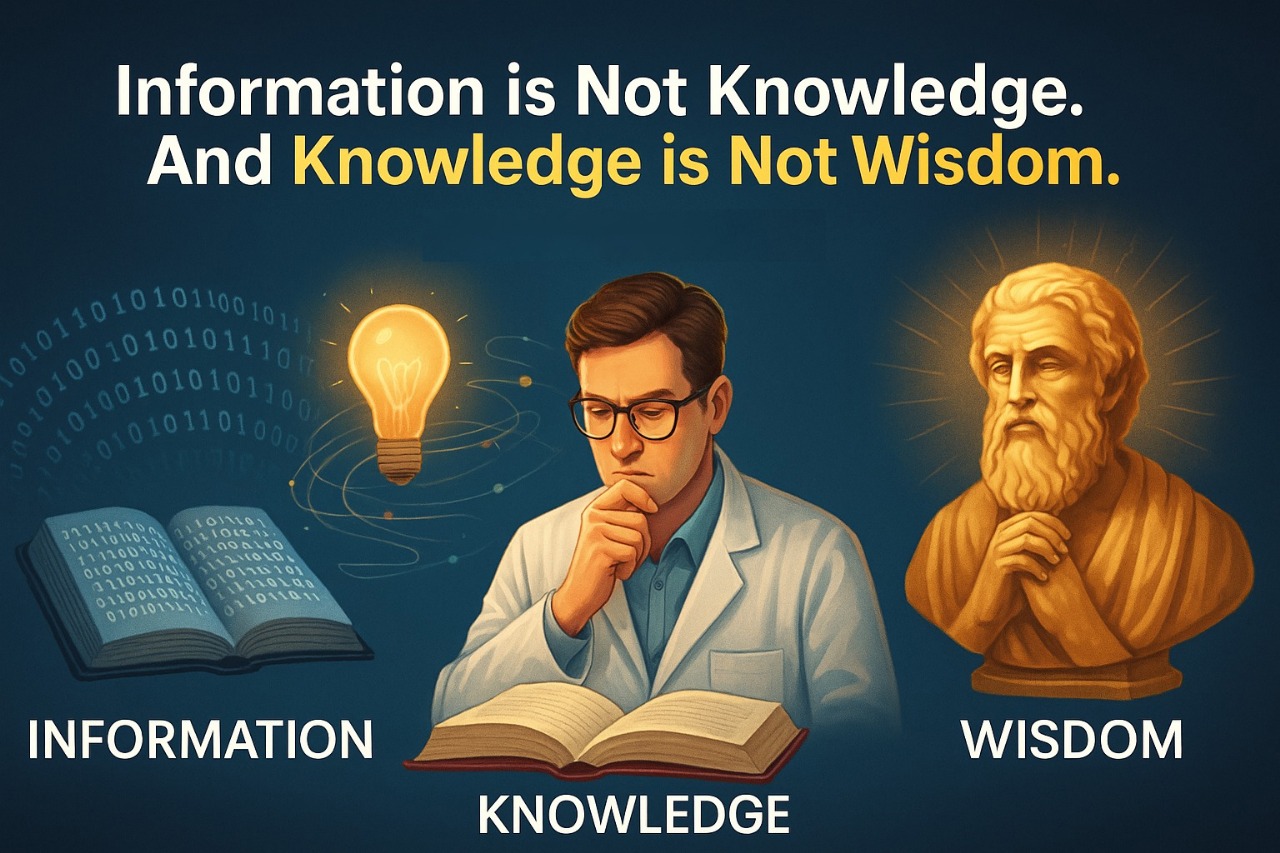
To understand how clinical decisions are actually made, it is useful to distinguish three sequential epistemic layers through which a decision passes. This framework, not often made explicit in clinical education, clarifies where science ends and judgment begins.
Science
Judgment
Action
Evidence provides general knowledge about what is likely to benefit patients with a given condition. Interpretation applies that knowledge within the particular clinical context — weighing the patient’s comorbidities, values, and preferences. Decision translates the interpreted evidence into a concrete action, in dialogue with the patient.
Critically, each layer involves a different kind of reasoning. Evidence operates through statistical inference. Interpretation operates through clinical judgment. Decision operates through practical wisdom — the capacity to act well under conditions of irreducible uncertainty.
An error at any layer distorts the final decision. Misreading the evidence, misapplying it to the wrong patient, or failing to translate it into an appropriate action — each represents a distinct failure mode that neither better trials nor better guidelines can prevent alone.
V. The Role of Clinical Judgment
Clinical judgment emerges in the interpretive layer — the space where evidence, stripped of the population context in which it was produced, must be re-clothed in the particulars of an individual patient’s situation.
Judgment integrates multiple sources of knowledge: research evidence, clinical experience, biological understanding, patient preferences, and situational context. Through judgment, the physician asks not merely whether a treatment works in general, but whether it is appropriate for this patient at this moment.
Return to the opening vignette. The evidence supports ACE inhibitors in heart failure. Judgment recognises that initiating them in a patient with borderline renal function requires careful dose titration and monitoring, that the patient’s concerns about pill burden deserve direct discussion, and that a shared decision — even one that initially departs from the guideline — may produce better long-term adherence and outcomes than mechanically imposed treatment.
Judgment functions as the bridge between scientific knowledge and clinical action. Without it, medicine treats guidelines rather than patients.
VI. Reasoning Under Uncertainty: The Bayesian Dimension
Medical decisions rarely occur under conditions of certainty. Diagnostic tests have false positive and false negative rates. Diseases evolve over time. Presentations are ambiguous. Even the strongest trial evidence rarely delivers absolute conclusions — it delivers probabilities.
“ BAYESIAN REASONING IN CLINICAL MEDICINE
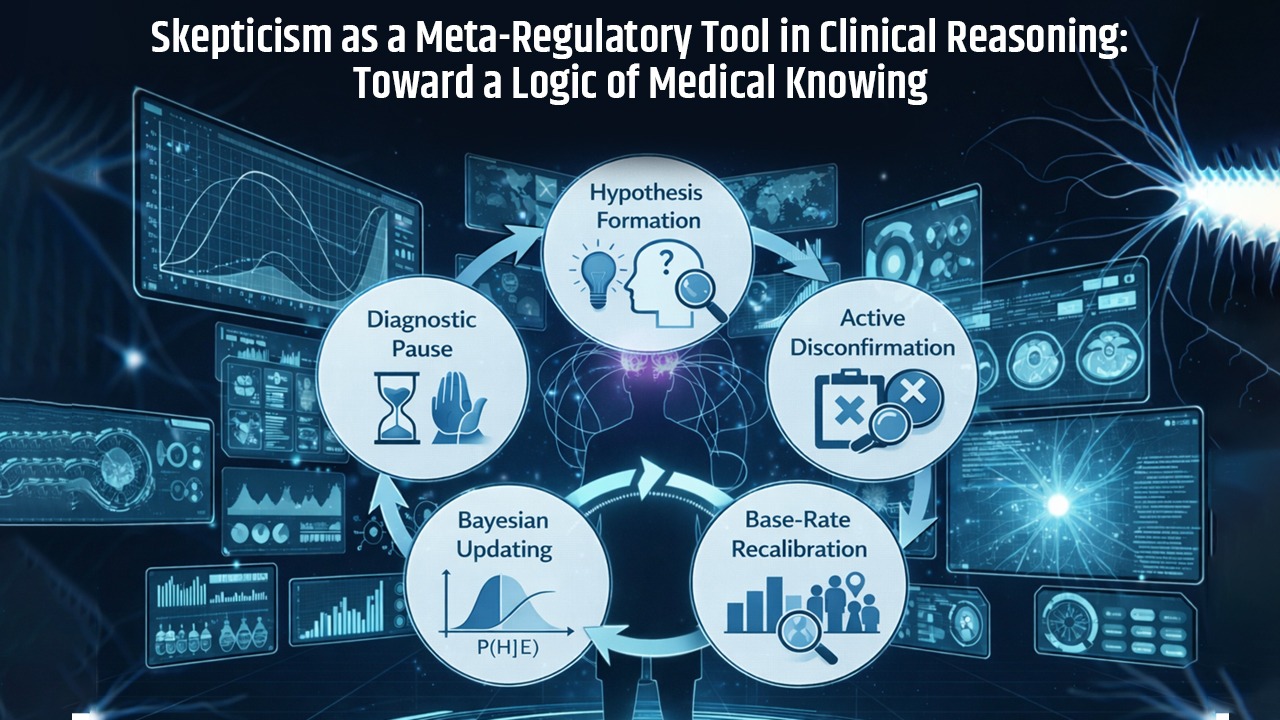
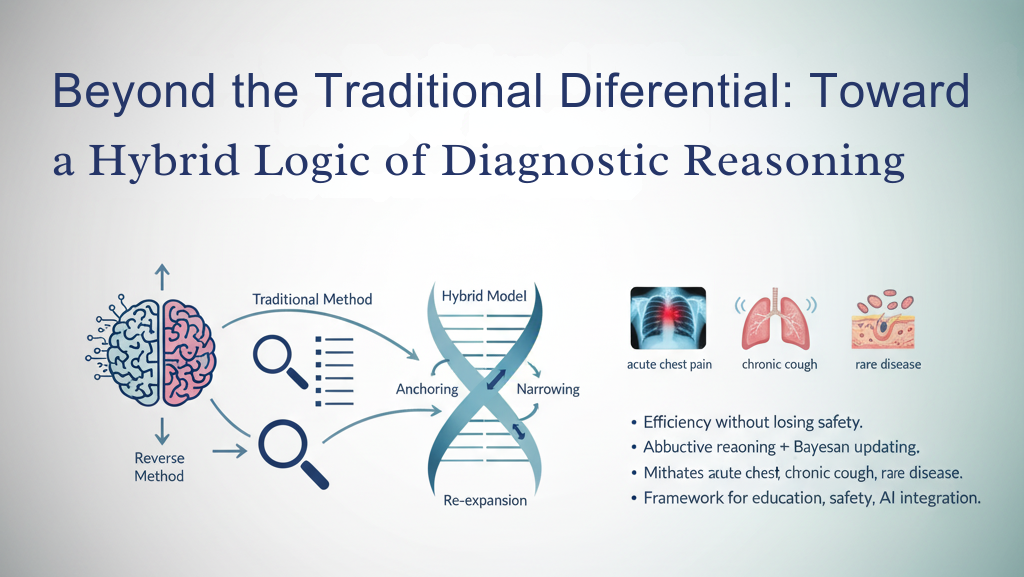
Bayesian reasoning offers a formal framework for understanding how clinicians update their diagnostic beliefs. A clinician begins with a prior probability — the pre-test likelihood of a diagnosis based on epidemiology and clinical context — and revises this estimate as new evidence arrives. The posterior probability that emerges is not a fixed truth but a continuously updated best estimate. This probabilistic logic underpins the interpretation of sensitivity, specificity, and predictive values — and explains why the same test result carries different significance in a high-prevalence versus low-prevalence population.
Clinical reasoning therefore has the structure of inference to the best explanation: the clinician maintains several competing hypotheses and updates their relative probability as new data emerge. But this process is always provisional. The diagnosis that appears most likely today may be revised tomorrow when the patient fails to respond to treatment, or when a new investigation returns an unexpected result.
This provisional nature of clinical knowledge is not a weakness to be overcome — it is an accurate reflection of the epistemic situation medicine operates within. The appropriate response is not false certainty but calibrated confidence: strong enough to act on, humble enough to revise.
VII. The Cognitive Dimension: Pattern Recognition and Bias
Experienced physicians develop rich pattern recognition through years of clinical exposure — the capacity to detect subtle signals, atypical presentations, and incongruent findings that statistical models may miss. This dual-process character of clinical thinking is well documented in cognitive psychology. Both modes are valuable: pattern recognition enables efficient decision-making in time-pressured environments, while deliberative analysis catches errors that intuition might perpetuate.
But human cognition is also systematically imperfect. Several cognitive biases recurrently affect clinical judgment:
| COGNITIVE BIAS | CLINICAL MANIFESTATION |
|---|---|
| Anchoring | Over-reliance on the first diagnosis considered, even as contradictory evidence accumulates. |
| Confirmation Bias | Selectively seeking evidence that supports the favoured hypothesis while discounting evidence against it. |
| Premature Closure | Accepting the most plausible diagnosis before all relevant data has been gathered or considered. |
| Availability Heuristic | Overestimating the probability of diagnoses that are easily recalled, often due to recent or dramatic cases. |
Evidence disciplines clinical thinking, while judgment adapts evidence to reality. Each corrects the characteristic weaknesses of the other.
VIII. Two Failures of Balance
Evidence without judgment risks rigidity. When guidelines are applied mechanically without interpretive contextualisation, medicine may treat diagnoses rather than patients. The term “cookbook medicine” captures this pathology: a technically proficient but humanly inadequate practice that follows protocols even when the patient’s circumstances clearly call for a different approach. This is not the fault of evidence-based medicine as a philosophy — it is a misapplication of it. Sackett’s original formulation explicitly required the integration of clinical expertise and patient values alongside best evidence.
Judgment without evidence risks drift. A practice grounded only in personal experience and intuition is vulnerable to the accumulated biases of that experience, to the influence of pharmaceutical promotion, to the authority of charismatic seniors, and to the natural human tendency to remember successes and forget failures. Historically, many therapies once confidently recommended — bloodletting, routine tonsillectomy, hormone replacement for cardiovascular prevention — were later shown by controlled trials to be ineffective or harmful. Evidence is the discipline that protects medicine from its own enthusiasms.
IX. A Philosophical Perspective: Practical Wisdom
From a philosophical perspective, medicine occupies a distinctive position among the sciences. Physics and chemistry operate, in their idealisations, within closed systems where causal relationships can be precisely specified and replicated. Medicine deals with open, dynamic, living systems embedded in biological complexity, social context, and historical individuality.
This is why medical knowledge is probabilistic rather than deterministic — not because medicine is an immature science, but because the phenomena it addresses are genuinely irreducible to law-like generalisations. The singularity of the patient is not an obstacle to medical knowledge; it is its central object.
Aristotle’s concept of phronesis — practical wisdom — captures what is required in this situation. Phronesis is not the application of universal rules to particular cases. It is the capacity to perceive what a situation requires and to act appropriately when rules underdetermine the right action. It develops through experience, reflection, and the accumulated moral seriousness of caring for patients over time.
In medicine, this wisdom manifests as the physician who knows when to follow guidelines and when to depart from them; who can hold uncertainty without collapsing into either false certainty or paralysed inaction; and who remains oriented toward the patient’s wellbeing as the ultimate criterion of good clinical practice.
Conclusion
Scientific evidence transformed medicine by displacing tradition, authority, and unexamined habit with rigorous, reproducible knowledge. This transformation is one of the greatest achievements of modern intellectual life. Yet the clinical decision does not end when the evidence is known.
The most accurate understanding of clinical decision-making is one of integration: evidence and judgment are not rivals but complements — each necessary, neither sufficient.
A physician who ignores evidence risks practicing outdated medicine, repeating the errors of the past, and exposing patients to harm that knowledge could have prevented. A physician who ignores judgment risks treating protocols rather than people, missing the patient standing in front of them in favour of the population represented in a table.
Good medicine has always required both. Its future depends on understanding their relationship with greater precision.
Evidence maps the landscape of medicine. Judgment guides the physician through it.
Science provides the knowledge of what is possible. Wisdom decides what is right.
Good medicine does not end with evidence. It begins there.
――― ✶ ―――
Selected References
[1] Sackett DL, Rosenberg WMC, Gray JAM, Haynes RB, Richardson WS. Evidence based medicine: what it is and what it isn’t. BMJ. 1996;312:71–72.
[2] Greenhalgh T, Howick J, Maskrey N. Evidence based medicine: a movement in crisis? BMJ. 2014;348:g3725.
[3] Kahneman D. Thinking, Fast and Slow. New York: Farrar, Straus and Giroux; 2011.
[4] Graber ML, Franklin N, Gordon R. Diagnostic error in internal medicine. Arch Intern Med. 2005;165:1493–1499.
[5] Sox HC, Higgins MC, Owens DK. Medical Decision Making. 2nd ed. Oxford: Wiley-Blackwell; 2013.
[6] Aristotle. Nicomachean Ethics. Book VI. [Classical account of phronesis — practical wisdom.]
[7] Ioannidis JPA. Why most published research findings are false. PLoS Med. 2005;2(8):e124.




Leave a Reply