
“Healing is not the conquest of disease, but the quiet mathematics of becoming—where life moves infinitely closer to wholeness, even when perfection remains beyond reach.”
Beyond the Illusion of Cure
Medicine often teaches us to think in endpoints. A patient is cured, the disease is eliminated, the scan is clear, and the case is closed. Resolution becomes the silent metric of success.
Yet clinical life rarely obeys such geometric finality.
Many illnesses do not end — they evolve. Many patients do not return to who they once were — they reorganise into new versions of themselves. Strength reappears, function improves, and meaning is renegotiated, but complete restoration remains uncommon.
Over time, the physician begins to recognise a deeper truth:
Healing is often directional rather than terminal.
To understand this movement, we may borrow a concept from mathematics — the asymptote.
The Geometry of Recovery
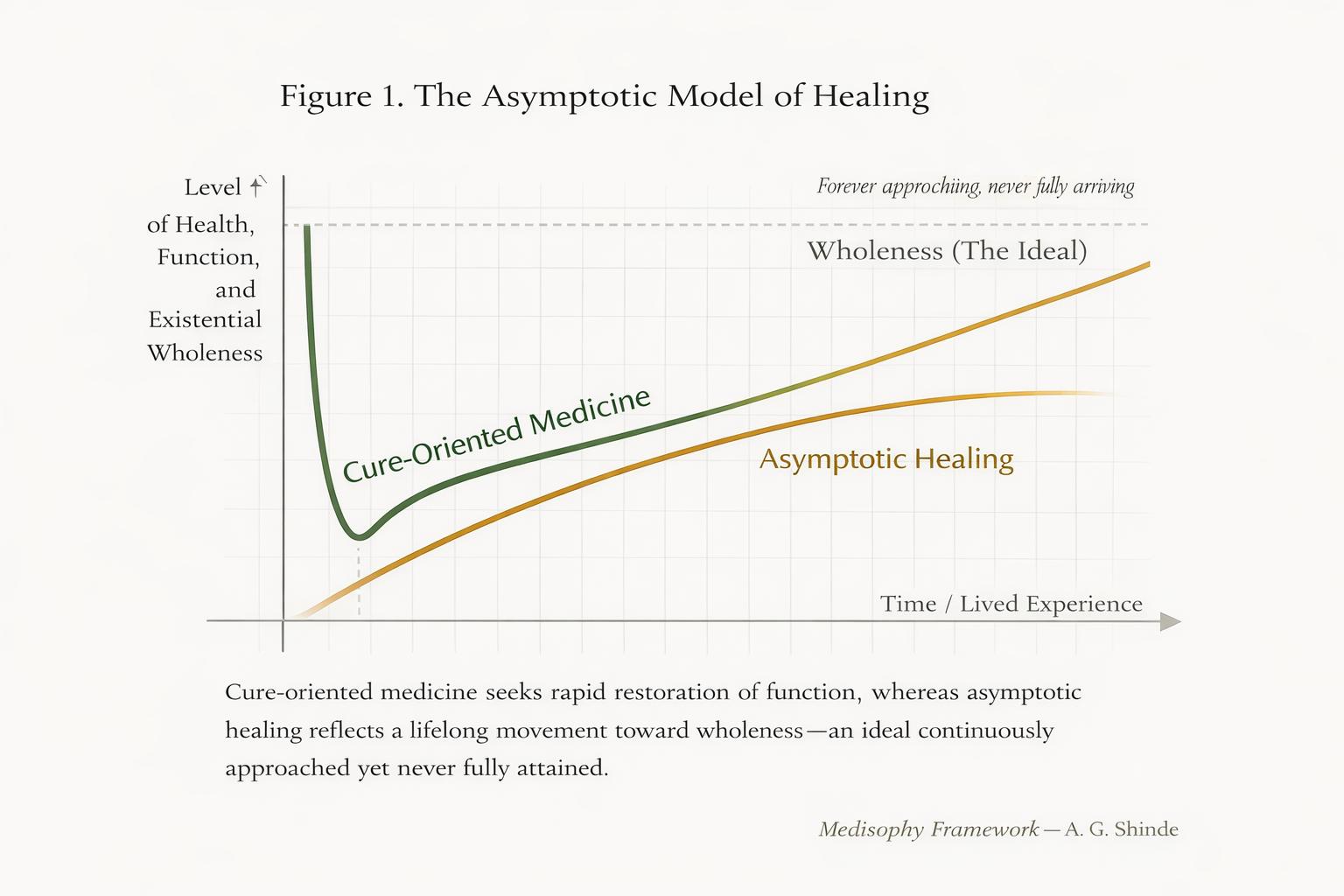
An asymptote is a line that a curve approaches endlessly without ever touching. The distance narrows with persistence; progress is undeniable. Yet completion remains structurally unreachable.
Such a state is not failure.
It is the architecture of certain kinds of growth.
So too in medicine, many forms of healing unfold as sustained approximations toward wholeness rather than acts of arrival.
Asymptotic Healing:
A mode of recovery in which a person moves progressively toward functional, psychological, and existential integration without presuming total biological restoration.
Such a view does not diminish medicine’s power — it refines its imagination.
When Progress Replaces Perfection
Consider the young woman recovering from a spinal cord injury. Months of rehabilitation teach her body new pathways; years cultivate resilience and ingenuity. She may never run — yet she walks, works, laughs, and inhabits a life once thought unreachable.
Or the individual living with diabetes, whose daily acts of discipline quietly transform vulnerability into stewardship. The illness remains, but so does vitality.
In psychiatry, one encounters patients who learn not the elimination of fragility but the art of living intelligently alongside it. Stability becomes less a destination than a rhythm.
These are not incomplete recoveries.
They are asymptotic victories — lives expanding even as perfection recedes.
Healing here is not the disappearance of disease but the widening of possibility.
The Physician’s Unlearning
Early in training, success is often measured numerically — cholesterol reduced, lesions resolved, laboratory values disciplined into range. Medicine appears solvable.
Experience complicates this arithmetic.
One meets patients who remain medically imperfect yet existentially whole and others who achieve biological cures yet feel estranged from their own lives.
Gradually, a quieter understanding emerges:
Healing is not always the restoration of a prior life — it is frequently the construction of a liveable new one.
This realisation humbles the clinician. Mastery over disease, while noble, is not the sole measure of care. Equally vital is participation in the patient’s ongoing re-authorship of self.
When Cure Happens — Yet Healing Continues
Modern medicine performs undeniable miracles. Organs are transplanted, malignancies fall silent, and infections vanish.
Yet even when biology resolves, the human story does not rewind.
Survivors often speak of altered horizons — a heightened awareness of fragility, a reordering of priorities, and an identity subtly rewritten by proximity to loss.
The body may recover.
The biography has changed.
Biological resolution does not automatically confer existential restoration.
The asymptote persists—sometimes in memory, sometimes in identity, always within the unfolding narrative of being human.
The Emotional Geometry of Being Alive
Our inner lives obey similar mathematics.
Grief rarely disappears; it reorganises. Trauma seldom evaporates; it is metabolised into story. Loss becomes integrated rather than erased.
To accept is not to forget — it is to live without continuous fracture.
Over time, many discover that healing does not require the absence of pain, but its transformation into something that no longer dominates the architecture of the self.
One moves closer to equilibrium, even while the original wound remains part of one’s personal topology.
This too is asymptotic healing.
Medicine Grows Up
As medicine matures, it slowly shifts from a science obsessed with correction to a discipline capable of accompaniment.
The physician is no longer merely a fixer of broken physiology but a steady presence within uncertain terrain.
Expectations soften. Hope detaches from perfection. Care becomes longitudinal rather than episodic.
Patients rarely demand guarantees.
What they seek is steadiness — a companion credible enough to remain when certainty recedes.
There is quiet ethical wisdom in accepting that some distances cannot be fully closed.
When medicine relinquishes the illusion of total control, it becomes more honest — and paradoxically, more trustworthy.
Healing as Becoming
Seen clearly, clinical work is not merely the management of pathology. It is participation in an unfolding human transformation.
Physicians do not simply return lives to what they once were; they help shape the lives those persons are still capable of becoming.
Healing, therefore, is less a moment than a movement — less an event than a disciplined direction.
It asks of the clinician both scientific rigour and philosophical maturity: the courage to intervene decisively and the humility to accept that wholeness is often approached rather than possessed.
Closeness as Sufficiency
Medicine advances through astonishing precision and technological brilliance. Yet its deepest wisdom may lie in recognising that not all healing culminates in restoration.
The asymptote teaches restraint — an intellectual humility that honours both the power and the limits of clinical science.
For the physician, this marks a quiet maturation: the shift from pursuing a cure at all costs to stewarding trajectories of dignity, function, and meaning.
Patients do not always need the promise of arrival.
More often, they need companions credible enough to walk beside them.
And perhaps that is the higher calling of medicine — not merely to restore life, but to help shape the life that continues.
To heal, then, is not always to close the distance —
but to ensure it is forever narrowing.

Leave a Reply