
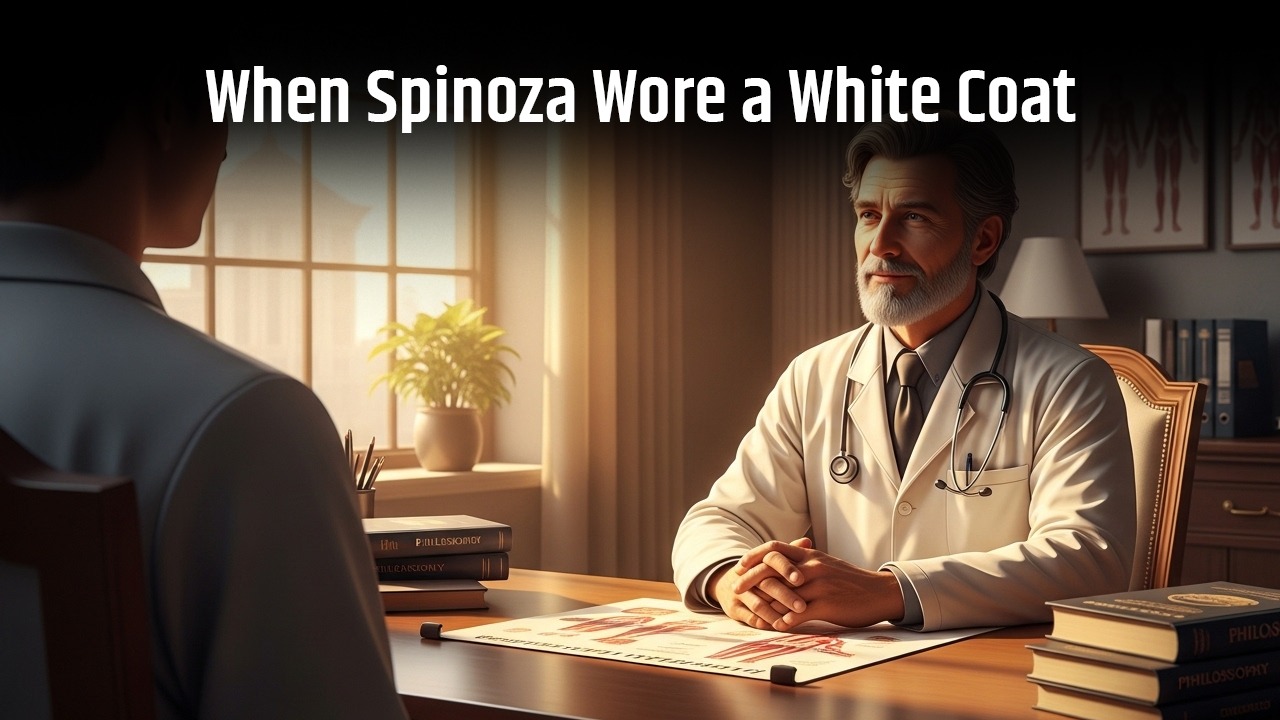
What would it mean if Baruch Spinoza—the 17th-century philosopher of reason, determinism, and joy—walked into our world today, wearing a white coat and sitting in a clinic? It is tempting to smile at the thought, but the more one reflects, the more one realises that his philosophy carries a deep medical resonance. Spinoza in a clinic would not be a flight of fancy; it would be a radical reimagining of what healing could mean.
Illness As Necessity, Not Misfortune
Spinoza rejected the idea of chance. For him, everything unfolds through necessity — a vast, interwoven chain of causes. Illness, then, would not appear to him as a random misfortune. A patient’s diabetes or hypertension would be understood as the logical consequence of biology, environment, habits, and stress, all playing their part in a determined order.
This perspective does not trivialise suffering. On the contrary, it transforms it: disease is not a punishment, nor a cruel accident, but part of the unfolding of life’s causal web. In understanding this necessity, the patient and physician both move away from blame and toward clarity.
The Conatus Of Healing
One of Spinoza’s most profound ideas is conatus—the striving of each being to persist in its own existence. In the clinic, this concept would become the foundation of medical practice.
A prescription, to Spinoza, would not be a weapon against the body. It would be an ally of the body’s own striving. Medicine would be seen as a tool to assist the organism’s conatus—its innate drive toward preservation and equilibrium. Healing, then, is not an act imposed from outside but a collaboration with the body’s natural momentum to endure and flourish.
The Emotional Weight of Illness
Spinoza devoted as much attention to emotions as to metaphysics. He distinguished between passive emotions (fear, despair, resentment) that diminish our power of acting and active emotions (rational joy, acceptance, understanding) that expand it.
Imagine him in consultation with a patient newly diagnosed with cancer. He would acknowledge fear but also try to gently shift the patient toward understanding—from being overwhelmed by blind passion to finding active engagement. “To know your illness is to begin to free yourself from its emotional captivity,” he might say.
For Spinoza, medicine without attending to emotions would be incomplete, for fear can constrict the healing power just as much as a failing organ.
Ethics As Therapy
At the heart of Spinoza’s philosophy lies the idea that to understand reality is to become free. The physician’s role, then, is not only to treat but to educate — to lead the patient toward a deeper knowledge of their condition, its causes, and its place in the broader order of life.
In such a clinic, ethical philosophy itself would become a therapy. Patients would leave not only with medicines but also with a shift in perspective—an ability to see their suffering not as meaningless chaos but as something intelligible. Such understanding does not cure all disease, but it changes the texture of living with it.
Medicine As Joy
Spinoza defined the highest human good as joy born of understanding. Healing, then, would not merely be the absence of disease but the presence of clarity, acceptance, and empowerment. The white coat, in his hands, would not symbolise authority but a quiet commitment to help others see themselves as part of nature’s vast, necessary unfolding — and to find freedom within that vision.
A Clinic Of Philosophy
What would such a clinic look like? Perhaps less hurried. Perhaps quieter, more conversational. A place where diagnosis is not a reduction of the person to numbers but a reconstruction of meaning. A place where the prescription pad is balanced by philosophy, and where both physician and patient walk away not only with pills, but with perspective.
Spinoza never wore a white coat. But if he did, he would remind us that medicine is not only about curing diseases but also about helping human beings live wisely and fully, even in the face of necessity. In this sense, every clinic has the potential to become a small space of Spinozist healing—if only we dare to practise medicine as philosophy.








Amit Hartalkar
Wow. This is such a unique way to look at the gradually vanishing touch of ‘humanness’ from medical practice. Very well imagined and equally well articulated. Enjoyed and learnt a lot.