
Introduction: The Problem Every Clinician Faces
Every clinical encounter begins with uncertainty. A patient arrives carrying symptoms—pain, fever, fatigue, and breathlessness—and the physician must sift through history, physical examination, laboratory data, and imaging to construct a coherent explanation. This process is called clinical reasoning, and it sits at the very heart of medical practice.
Yet clinical reasoning is more than a technical skill. It is a philosophical activity. At its core lies a deceptively simple question:
Should we seek one explanation for all findings, or should we entertain many explanations simultaneously?
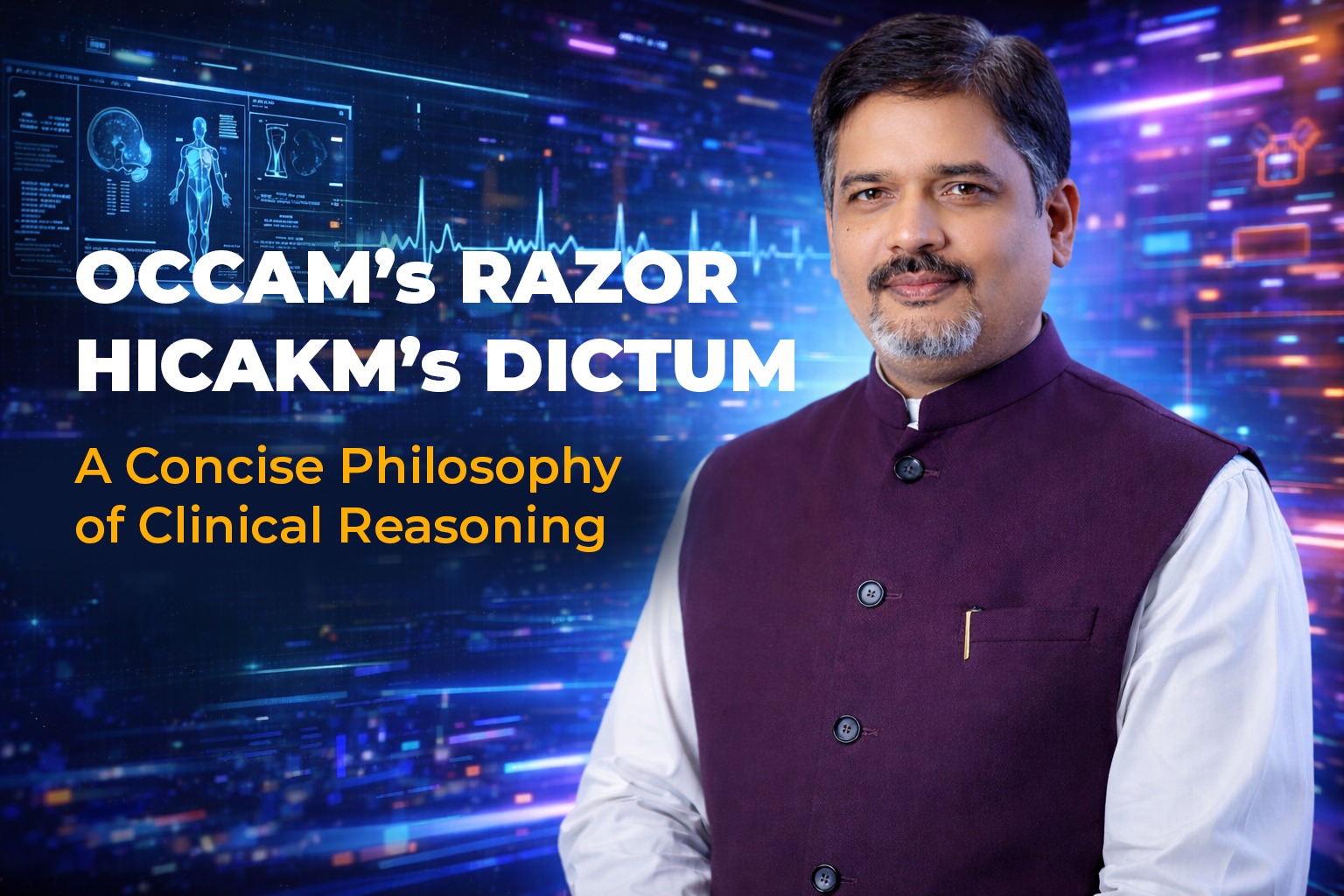
This question has shaped medical thinking for decades. It is expressed through two enduring principles: Occam’s Razor and Hickam’s Dictum. Understanding them helps us understand not just how doctors think, but why skilled clinicians sometimes reach opposite conclusions from identical evidence.
Occam’s Razor: The Preference for Simplicity
Occam’s Razor derives from the mediaeval philosopher William of Ockham, who argued that, given competing explanations, the one requiring the fewest assumptions is usually correct. The principle has been distilled to a memorable maxim: “Entities must not be multiplied beyond necessity.”
In medicine, this translates into a powerful clinical heuristic: when a patient presents with multiple findings, look first for the single disease that accounts for all of them. Classic examples include:
• Fever, weight loss, and cavitary lung lesions → tuberculosis
• Rash, polyarthritis, and proteinuria → systemic lupus erythematosus
• Fatigue, bradycardia, and cold intolerance → hypothyroidism
The value of this approach is considerable. A unifying diagnosis keeps reasoning organised, guides targeted investigation, and exposes the underlying pathophysiological mechanism connecting seemingly disparate findings. Medical education rightly encourages students to search for the single, elegant explanation before invoking additional diagnoses.
Why Simplicity Matters
A unifying diagnosis reduces unnecessary testing, limits polypharmacy risk, clarifies prognosis, and reflects sound probabilistic reasoning—rare coincidences of multiple unrelated diseases are, by definition, uncommon.
However, nature is under no obligation to honour our preference for elegance.
Hickam’s Dictum: Embracing Complexity
John Bamber Hickam, an American internist and educator, offered a counterpoint that every seasoned clinician recognises from experience. His dictum, often paraphrased, captures a practical truth of modern medicine:
Patients are free to have as many diseases as they desire.
John B. Hickam, MD
The bluntness is deliberate. Biological systems are complex. Comorbidity is common, particularly in elderly, immunocompromised, or chronically ill patients. Consider:
• An 80-year-old admitted with confusion may have a concurrent urinary tract infection, hyponatraemia, and early Alzheimer’s disease—each independently contributing to the clinical picture.
• A poorly controlled diabetic with chest pain may have both pneumonia and acute coronary syndrome conditions that can coexist and even potentiate each other.
Forcing all findings into a single diagnosis in such cases risks missing a treatable condition entirely. Hickam’s Dictum is therefore not an invitation to diagnostic chaos; it is a safeguard against the equally dangerous error of premature simplification.
Clinical Implication
When initial treatment for the “unifying” diagnosis fails to produce the expected response, Hickam’s Dictum should prompt the clinician to ask, “What else might be present?”
Comparing the Two Principles
Rather than viewing these principles as opposites, experienced clinicians use them as complementary lenses.
| Occam’s Razor | Hickam’s Dictum |
|---|---|
| Prefer a single unifying diagnosis | Accept multiple concurrent diagnoses |
| Ideal for younger patients with acute illness | Essential in elderly and multimorbid patients |
| Reduces diagnostic noise and redundant testing | Prevents anchoring to a convenient but incomplete picture |
| Strong in textbook presentations of classical disease | Strong when treatment response is partial or atypical |
| Risk: Premature closure on a compelling but incomplete explanation | Risk: Diagnostic fragmentation and over-investigation |
The Human Element: Cognitive Biases in Clinical Reasoning
Clinical reasoning is performed by human minds, not by infallible algorithms. Physicians routinely employ rapid pattern recognition—a valuable skill built through years of experience. But this same capacity for quick inference opens the door to systematic errors known as cognitive biases.
Three biases are especially relevant to the Occam–Hickam tension:
| Bias Type | Description |
|---|---|
| Anchoring Bias | The tendency to fix on the first diagnostic impression and interpret subsequent findings through that lens, even when new evidence points elsewhere. |
| Confirmation Bias | Selectively weighting information that supports a favored hypothesis while discounting contradictory data. |
| Premature Closure | Stopping the diagnostic search once a plausible explanation has been found, before considering whether additional conditions may be present. |
Hickam’s Dictum serves as a useful cognitive circuit-breaker. When a simple explanation appears compelling, it reminds the clinician to pause and ask whether the case has been truly closed—or merely abandoned for the comfort of certainty.
Conversely, Occam’s Razor guards against a different failure mode: the generation of endless differential diagnoses that paralyses decision-making and subjects patients to unnecessary investigations.
Diagnosis as Reasoning Under Uncertainty
Medicine is irreducibly probabilistic. Symptoms are often non-specific, tests have known false-positive and false-negative rates, and diseases evolve over time in ways that can transform the diagnostic picture entirely. The physician must make decisions not when certainty has been achieved, but while uncertainty is still substantial.
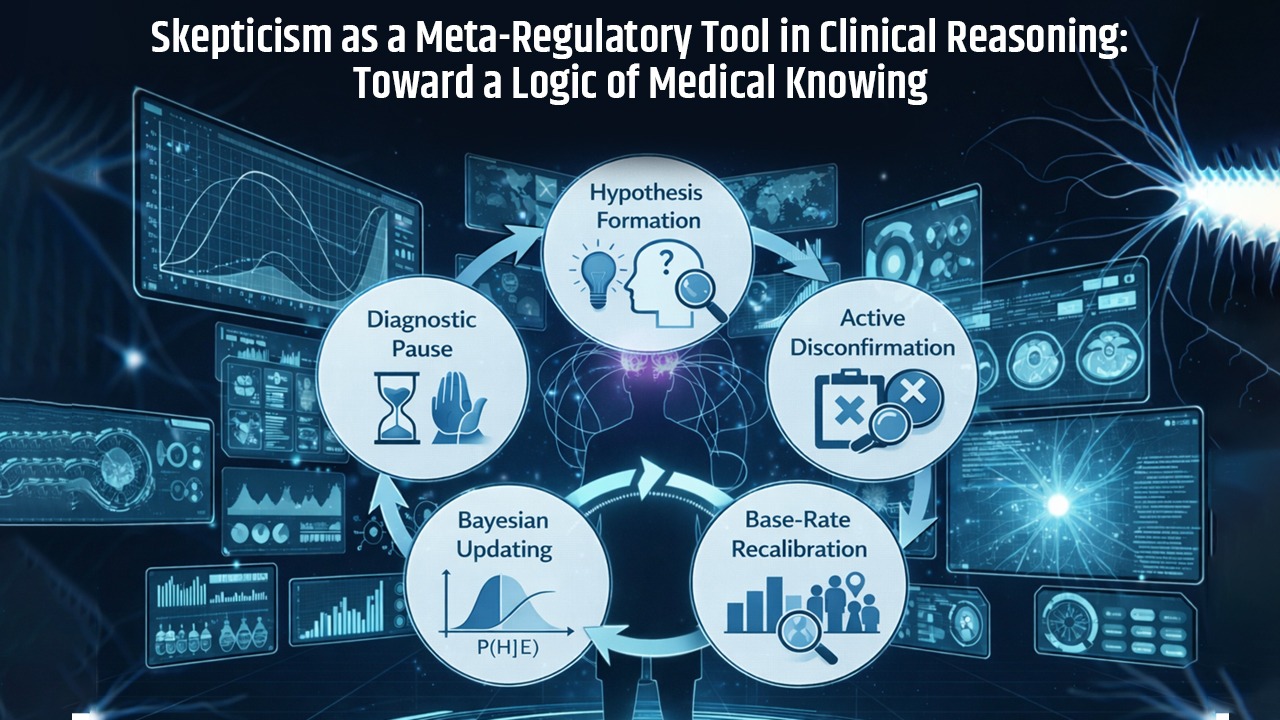
This reality has important implications. A diagnosis is not a final answer but a working hypothesis—the most reasonable interpretation of available evidence at a given moment. When new information arrives, responsible clinical reasoning demands revision:
• A patient treated for community-acquired pneumonia who fails to improve after 48 hours demands reconsideration: atypical organism? Secondary empyema? Underlying malignancy?
• A stroke diagnosis that explains left-sided weakness may not explain a simultaneous new murmur—raising the possibility of infective endocarditis as an embolic source.
The willingness to revise is not a sign of diagnostic weakness. It is the hallmark of a careful, intellectually honest clinician.
A Practical Framework: When to Apply Each Principle
While no rule replaces clinical judgement, the following framework offers a starting orientation:
| Clinical Context | Favour Occam’s Razor | Favour Hickam’s Dictum |
|---|---|---|
| Patient age / frailty | Young, previously healthy patient | Elderly or multimorbid patient |
| Presentation pattern | Classic, textbook constellation of findings | Atypical, mixed, or overlapping symptoms |
| Treatment response | Responds as expected to targeted therapy | Partial, absent, or paradoxical response |
| Epidemiology | High pre-test probability for a single disease | Multiple independent risk factors present |
Conclusion
Clinical reasoning is the intellectual core of medical practice. It requires the physician to interpret ambiguous evidence, weigh competing hypotheses, and act decisively despite incomplete information—all while remaining genuinely open to revision.
Occam’s Razor and Hickam’s Dictum are not enemies. They are complementary tools in the diagnostic armamentarium. The first pushes the clinician toward parsimony and elegance; the second insists on intellectual humility and completeness. Mastery lies not in choosing one over the other but in developing the judgement to know which the clinical situation demands.
Textbooks prefer simple explanations. Nature frequently presents a more complicated reality. The skilled clinician learns to live comfortably in the space between.
As medicine grows more complex—with ageing populations, novel comorbidities, and increasingly sensitive diagnostics that uncover incidental findings—the tension between simplicity and complexity will only intensify. Clinicians who understand the philosophical foundations of their reasoning will be better equipped to navigate that tension with wisdom, care, and intellectual honesty.
About the Author
Dr Abhijeet G. Shinde is a consultant physician, author, and medical philosopher. He founded Thinking Healer to foster deeper intellectual engagement with clinical reasoning among medical practitioners.







Leave a Reply