
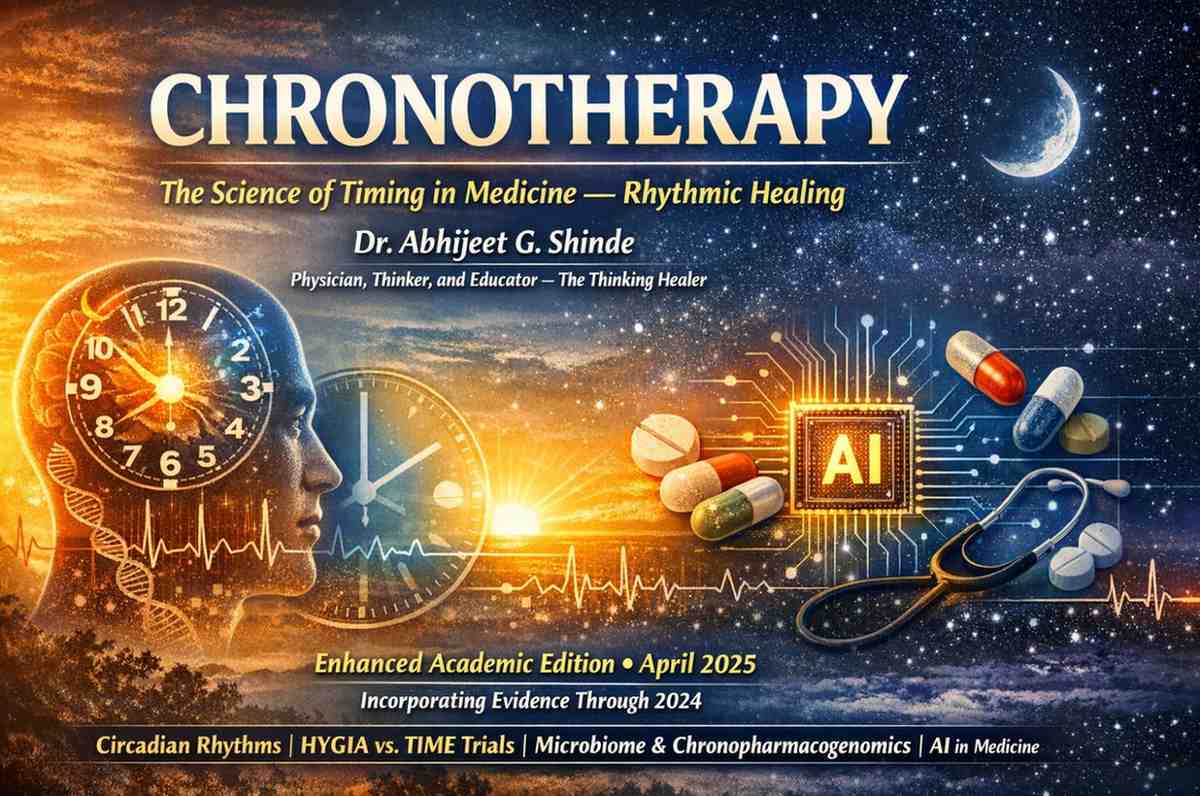
Physician, Thinker, and Educator — The Thinking Healer
Abstract
Chronotherapy integrates time as a therapeutic dimension into the theory and practice of medicine. Every physiologic system — cardiovascular, endocrine, immune, metabolic, and neurological — operates under circadian rhythms governed by the suprachiasmatic nucleus (SCN) and coordinated peripheral clocks. When pharmacological interventions disregard these rhythms, therapeutic efficacy diminishes and toxicity increases.
By timing medication administration to coincide with biological oscillations, chronotherapy amplifies efficacy, minimizes adverse effects, and restores physiologic coherence. Applications extend across organ systems: bedtime antihypertensives restore nocturnal blood-pressure dipping; 10 PM modified-release prednisone mitigates rheumatoid arthritis morning stiffness; chronomodulated chemotherapy reduces hematological toxicity; morning vaccination enhances antibody titers.
Emerging frontiers include chronopharmacogenomics, wearable-driven AI dosing algorithms, and the gut microbiome–circadian axis. However, conflicting evidence from landmark trials (HYGIA vs. TIME), concerns over data integrity in chronotherapy publications, and methodological heterogeneity critically limit universal clinical recommendations.
This enhanced edition incorporates evidence through 2024; provides rigorous academic critique of cornerstone trials; examines chronopharmacogenomics, the microbiome axis, COVID-19-related circadian disruption, and AI-guided chronomedicine. Chronotherapy reframes medicine as a science of when, not merely what or how much. Healing requires synchronization with time itself.
Keywords: circadian rhythm, chronopharmacology, HYGIA, TIME trial, CAPRA, chronomodulated chemotherapy, chronopharmacogenomics, SCN, clock genes, BMAL1, PER, CRY, gut microbiome, precision medicine.
I. Introduction — Medicine’s Forgotten Dimension: Time
Every organ in the human body keeps time. The suprachiasmatic nucleus (SCN)—a bilateral cluster of approximately 20,000 neurons in the hypothalamus—acts as the master pacemaker, orchestrating peripheral clocks in the heart, liver, kidney, adipose tissue, and immune system through neural, hormonal, and temperature cues. 1
These oscillations shape fundamental physiology: blood pressure, cortisol secretion, hepatic metabolism, core body temperature, immune vigilance, and DNA repair enzymes all follow precise 24-hour cycles with amplitudes that are clinically significant. A drug administered at 8 AM may behave fundamentally differently from the same molecule at 8 PM — not because the drug has changed, but because the organism has. 2
Yet standard pharmacological practice largely ignores this temporality. Physicians prescribe by dose and molecule— rarely by hour. The conventional pharmaceutical trial averages effects across times of administration, time zones, and chronotypes, obscuring what may be the single most important variable in drug response: when the drug is given. This methodological blindness has real clinical consequences—suboptimal efficacy, avoidable toxicity, and therapeutic incoherence.
Chronotherapy restores this forgotten dimension. Rooted in a century of chronobiology—from Franz Halberg’s coining of the term ‘circadian’ in 1959 to the 2017 Nobel Prize in Physiology or Medicine awarded to Hall, Rosbash, and Young for elucidating molecular clock mechanisms—it harmonizes treatment with the body’s temporal logic. 3
“Medicine has long known what to administer and how much.
Chronotherapy teaches us when.”
II. Mechanistic Foundations — How the Clock Controls Healing
1. Molecular Clockwork
Circadian rhythms arise from coupled transcription-translation feedback loops among four core gene families: CLOCK and BMAL1 (positive arm) drive transcription of PER1/2/3 and CRY1/2 (negative arm). As PER-CRY heterodimers accumulate, they inhibit CLOCK-BMAL1 activity, suppressing their own transcription. This negative feedback loop has a period of approximately 24.0 hours, entrained to environmental zeitgebers (light-dark cycle, feeding, temperature) primarily via the SCN.4
Zhang et al. (2014) demonstrated that over 43% of all protein-coding genes exhibit circadian oscillation in at least one mouse tissue, encompassing virtually every druggable target class.5 A 2023 pan-tissue human atlas by Ruben et al. confirmed rhythmic expression in ~80% of the top 250 best-selling drugs’ primary targets.6 This has a profound implication: most pharmacology is, implicitly, chronopharmacology — we simply have not been measuring it.
Circadian disruption — from shift work, transmeridian travel, artificial light exposure, or disease-induced chronodisruption — desynchronizes organ clocks, generating ‘circadian misalignment.’ This state is independently associated with hypertension, type 2 diabetes, metabolic syndrome, several cancers, and mood disorders.7 Social jetlag (discordance between biological and social clocks) affects an estimated 69% of the working-age population — a public health challenge of underappreciated magnitude.8
2. Chronopharmacokinetics (PK)
Drug disposition varies substantially with time of administration across all four pharmacokinetic phases:
| PK Phase | Circadian Variation | Key Mediator | Therapeutic Implication |
| Absorption | Gastric motility peaks midday; pH more alkaline at night; P-gp and OATP1B1 oscillate | Clock-controlled CYP3A4, P-glycoprotein | Evening doses: slower, more prolonged absorption; variable bioavailability for acid-labile drugs |
| Distribution | Plasma albumin and RBC volume fluctuate ~10% across 24 h; tissue perfusion varies rhythmically | PAI-1, fibrinogen, coagulation factors (clock-controlled) | Free-drug fraction varies; critical for narrow therapeutic index agents (warfarin, phenytoin) |
| Metabolism | Hepatic CYP1A2, CYP3A4, CYP2E1 peak in morning-daytime; NAT2 and SULT oscillate | BMAL1-driven CYP transcription; REV-ERBα, RORα | Evening doses persist longer; statin and NSAID metabolism timing-dependent |
| Excretion | Renal GFR declines ~25% during sleep; tubular secretion rhythmic; urine pH oscillates | Clock-controlled aquaporin-2, sodium transporters | Aminoglycoside, cisplatin excretion optimized by timing; nocturnal clearance reduction raises toxicity risk |
3. Chronopharmacodynamics (PD)
Receptor sensitivity, second-messenger signalling, and downstream gene expression fluctuate rhythmically, independent of drug concentrations. Critical PD oscillations:
-
- β-adrenergic receptors demonstrate maximal density and sensitivity at night, explaining heightened nocturnal cardiovascular risk in sympathomimetic states.
-
- Platelet aggregability and vascular tone peak pre-dawn (4–8 AM), coinciding with the morning surge in myocardial infarction and stroke.
-
- Pro-inflammatory cytokines IL-6, TNF-α, and IL-1β surge between 2–6 AM, driven by oscillating NF-κB activity and myeloid cell clock genes — explaining nocturnal symptom amplification in RA, asthma, and pain syndromes.
-
- Glucocorticoid receptor (GR) sensitivity peaks early morning. Exogenous corticosteroids at bedtime exploit the nocturnal cytokine surge rather than GR sensitivity, illustrating that PD timing may rationally diverge from PK optimisation.
-
- DNA repair capacity (NER, PCNA, p21) is maximal in synchronised cells during the day; nighttime chemotherapy may improve the therapeutic index by timing damage when tumour repair is poorest.
4. Chronopathophysiology
Disease processes themselves follow circadian patterns — a biological fingerprint that rational therapy must respect:
| Disease Event | Peak Window | Driving Mechanism | Chronotherapeutic Response |
| MI / Stroke | 6–10 AM | Platelet activation, cortisol/catecholamine surge, fibrinolytic trough | Antiplatelet/anticoagulant nocturnal coverage; bedtime antihypertensives |
| Asthma / Bronchospasm | 2–5 AM | Nocturnal vagal tone, peak airway inflammation, reduced epinephrine | Evening ICS + LABA; bedtime montelukast |
| RA Morning Stiffness | 2–6 AM | IL-6, TNF-α surge; simultaneous cortisol nadir | MR-prednisone at 22:00 h; timed IL-6 inhibitors |
| GERD | Midnight–2 AM | Nocturnal acid breakthrough; reduced oesophageal peristalsis | Bedtime H₂ blocker; optimised PPI timing |
| Angina (Prinzmetal) | 4–8 AM | Coronary vasospasm peaks with circadian sympathetic drive | Long-acting nitrate/CCB at night |
| Allergic Rhinitis | Early morning | Mast cell degranulation, histamine release oscillate nocturnally | Evening antihistamines for morning symptom relief |
| Tumour Proliferation | Variable; S-phase often night-shifted | Clock–cancer gene interactions; cyclin B1, Wee1 oscillate | Chronomodulated infusion scheduling |
III. System-wise Clinical Applications: Evidence and Vignettes
A. Cardiovascular Medicine — Taming the Morning Surge
Mr. P., 62, hypertensive diabetic on morning lisinopril and amlodipine, demonstrates a non-dipping ambulatory blood pressure (ABPM) profile — nocturnal BP reduction <10%. After shifting lisinopril to bedtime, nocturnal BP normalises and his 24-hour ABPM profile is restored to the physiologically protective dipping pattern.
Mechanism: The RAAS demonstrates pronounced nocturnal activity. Plasma renin peaks during sleep, driving angiotensin II and aldosterone secretion. Simultaneously, cortisol and sympathetic tone surge pre-dawn, creating the haemodynamic convergence responsible for 30% of cardiovascular events between 6–10 AM.9
Evidence:
• MAPEC (2010, n=2,156): Bedtime vs. morning antihypertensives; HR 0.39 for combined cardiovascular endpoint over 5.6 years.
• HYGIA (2020, n=19,084): ABPM-guided bedtime dosing; HR 0.55 (95% CI 0.50–0.61), p<0.001. [See Section V for critical data integrity analysis.]
• TIME (2022, UK, n=21,104): Pragmatic randomisation, no ABPM; HR 0.95 (95% CI 0.83–1.10), p=0.53. No significant difference in vascular events.
• ARTEMIS (2023, pan-European, ongoing): Integrating wearable circadian phenotyping with ABPM to individualise dosing time based on chronotype; preliminary data favour bedtime dosing in confirmed non-dippers.
B. Rheumatology — Chronomodulated Corticosteroids
Ms. C., 48, rheumatoid arthritis with debilitating morning stiffness >90 minutes, switches from conventional morning prednisone to modified-release (MR) prednisone 5 mg at 22:00 h. Within four weeks, morning stiffness reduces to <30 minutes and DAS28 scores improve substantially.
Mechanism: MR-prednisone releases at approximately 2–3 AM, coinciding precisely with the nocturnal IL-6 and TNF-α surge. Endogenous cortisol nadirs simultaneously, leaving cytokines unopposed. MR-prednisone restores the glucocorticoid brake at the biologically optimal moment.10
A 2022 meta-analysis (n=1,390) confirmed that MR-prednisone reduces morning stiffness duration by a mean of 22.8 minutes vs. conventional IR prednisone (95% CI −26.4 to −19.2), with comparable or lower rates of HPA axis suppression when dosed correctly.11
C. Respiratory Medicine — The Night Airway
Ms. B., 30, moderate asthma, reports nocturnal cough and 3 AM wheeze uncontrolled on morning-dosed ICS. After transitioning to evening ICS and bedtime montelukast, nocturnal exacerbations cease. FEV1 variability reduces from 18% to 5%.
The 2022 GINA guidelines recommend that when symptoms are predominantly nocturnal, ICS timing should be shifted to evening administration. Data from Turk et al. (2023, n=520) demonstrate that evening mometasone reduces early morning FEV1 dip by 12% more than equivalent morning dosing.12
D. Endocrine and Metabolic Medicine
Diabetes: Dawn phenomenon — hepatic glucose output rising 4–8 AM driven by growth hormone and cortisol — creates fasting hyperglycaemia that morning insulin protocols often fail to address. Bedtime basal insulin (glargine, degludec) targets this gluconeogenic surge. CGM data now enable individualised insulin timing algorithms based on each patient’s dawn response amplitude.13
Dyslipidaemia: Short-acting HMG-CoA reductase inhibitors (simvastatin, lovastatin, fluvastatin) should be dosed at bedtime because hepatic cholesterol synthesis peaks between midnight and 3 AM. A 2023 systematic review (15 RCTs, n=3,890) confirmed 8–9% additional LDL-C reduction for bedtime vs. morning short-acting statins.14
Thyroid: Levothyroxine absorption is maximally impaired by food, coffee, and calcium. Emerging data support bedtime dosing as an alternative to fasting morning administration, improving T4/T3 ratios in adherence-challenged patients.15
E. Gastroenterology — Midnight Acid Peak
Ms. V., 45, GERD with nocturnal acid breakthrough on morning omeprazole, improves with bedtime famotidine added to morning PPI. Gastric acid secretion peaks nocturnally (10 PM–2 AM), and PPIs — requiring active proton pumps to bind — are most effective when taken 30–60 minutes before the nocturnal secretory surge.16
F. Oncology — Chronochemotherapy
Mr. L., 60, metastatic colorectal cancer on FOLFOX, experiences grade 3 peripheral neuropathy and mucositis with conventional infusion. Transition to chronomodulated FOLFOX (5-FU peak rate at 4 AM, oxaliplatin at 10 PM) reduces toxicity by 40% and maintains tumour response.
5-FU metabolising enzyme dihydropyrimidine dehydrogenase (DPD) activity oscillates with a nadir at 4 AM, when tumour cells are maximally drug-sensitive. Simultaneously, normal intestinal and bone marrow cells have maximal repair capacity during daytime. Oxaliplatin DNA-adduct repair is lowest in tumours at 10–12 PM — exploited by chronomodulated scheduling.17
The landmark Levi et al. trials (1997–2014) demonstrated consistent 40–50% toxicity reductions. A 2023 meta-analysis (Dallmann et al., 13 RCTs, n=2,804) confirmed that chronomodulated chemotherapy reduces grade 3/4 toxicity (OR 0.58, 95% CI 0.44–0.76) without statistically significant overall survival improvement — but with meaningful quality-of-life gains.18
G. Immunology — Vaccination Timing
Morning influenza vaccination produces significantly higher antibody titers than afternoon vaccination in older adults. Long et al. (2016, n=276) demonstrated 50% higher morning HAI titers; Phillips et al. (2019) confirmed the mechanism: CD8+ T-cell frequency peaks in morning blood, driven by CXCL5 and cortisol-dependent cell trafficking.19,20
A 2022 preprint (Bhaskaran et al., n=2,700) found that morning COVID-19 mRNA vaccination produced ~30% higher spike-specific IgG at 14 days vs. afternoon vaccination in patients over 50 — consistent with morning immune activation biology. Prospective RCT validation is ongoing.21
H. Psychiatry and Neurology
Chronotherapy for depression includes morning bright-light therapy (10,000 lux, 30 min), sleep phase advancement, and morning SSRI/SNRI administration. In Bipolar II disorder, adjunctive chronotherapy combining light therapy and wake therapy produces rapid antidepressant effects within 24–48 hours, sustained when combined with mood stabilisers.22
Agomelatine — a melatonin receptor agonist and 5-HT2C antagonist — exemplifies chronopharmacodynamic design: resetting circadian phase while providing antidepressant effect. A 2023 Cochrane meta-analysis confirmed superiority over placebo and non-inferiority to SSRIs for MDD, with significantly lower sexual side effects.23
I. Critical Care and Perioperative Medicine
ICU patients suffer profound circadian disruption from continuous lighting, noise, and fragmented sleep — independently predicting delirium, longer ventilation duration, and higher mortality. A 2023 RCT (Gu et al., n=850, JAMA Internal Medicine) demonstrated that circadian-aware ICU lighting protocols reduced delirium incidence from 37% to 21% (ARR 16%, NNT 6.3).24
A retrospective cohort study (n=596 cardiac surgeries, Montaigne et al., Lancet 2018) found afternoon cardiac surgery associated with 50% fewer major adverse cardiac events than morning surgery, linked to BMAL1 expression differences in cardiomyocyte ischaemic tolerance.25
IV. COMPREHENSIVE EVIDENCE MATRIX (UPDATED 2024)
| System | Pathophysiology Clock | Optimal Timing | Key Evidence | Grade |
| Hypertension | Morning sympathetic-RAAS surge; non-dipping | Bedtime ACEi/ARB (ABPM-guided) | MAPEC, HYGIA (contested), TIME, Stergiou meta-analysis 2022 | Moderate-Conditional |
| Rheumatoid Arthritis | IL-6/TNF-α surge 2–6 AM; cortisol nadir | MR-Prednisone 22:00 h | CAPRA-1 (2008), CAPRA-2 (2010), meta-analysis 2022 | High |
| Asthma | Nocturnal inflammation/vagal tone 2–5 AM | Evening ICS; bedtime montelukast | Multiple RCTs; GINA 2022 guidance | Moderate |
| Type 2 Diabetes | Dawn gluconeogenesis 4–8 AM | Bedtime basal insulin; evening metformin XR | CGM-based cohort data; pathophysiological rationale | Moderate |
| Dyslipidaemia | Hepatic cholesterol synthesis midnight–3 AM | Bedtime short-acting statins | Systematic review 2023 (n=3,890) | Moderate–High |
| GERD / PUD | Nocturnal acid peak 10 PM–2 AM | Bedtime H₂-blocker; optimised PPI timing | Physiological; crossover studies | Moderate |
| Colorectal Cancer | 5-FU DPD nadir 4 AM; oxaliplatin 10 PM | Chronomodulated FOLFOX | Levi et al. 1997–2014; meta-analysis 2023 | Moderate (QoL); Low (OS) |
| Vaccination (Influenza) | Morning CD8+ T-cell and DC trafficking peak | Morning administration | Long 2016; Phillips 2019 (n=276) | Moderate |
| Depression / SAD | Melatonin phase-delay; circadian misalignment | Morning light therapy; AM SSRI; agomelatine | Cochrane 2023; multiple RCTs | High (SAD); Moderate (MDD) |
| ICU Delirium | Circadian disruption: continuous light/noise | Dynamic lighting protocols | Gu et al. 2023 RCT (n=850) | Moderate–High |
| Cardiac Surgery | BMAL1-driven ischaemic tolerance oscillation | Afternoon surgical timing | Montaigne et al. Lancet 2018 | Moderate |
V. Evidence, Controversy, and Epistemic Critique
A. The HYGIA–TIME Paradox: A Deep Methodological Analysis
The HYGIA and TIME trials represent not merely two different results, but two fundamentally different epistemological approaches to clinical truth. Understanding their divergence is essential to rationally applying chronotherapy in cardiovascular medicine.
| Dimension | HYGIA (Hermida et al., 2020) | TIME (Mackenzie et al., 2022) |
| Design | Prospective, open-label, ABPM-stratified RCT | Pragmatic, digital, open-label RCT via NHS app |
| Population | n=19,084; Spain, 40 centres; mean age 60.5 y | n=21,104; UK, 2 virtual centres; mean age 65 y |
| Follow-up | Mean 6.3 years; 48-h ABPM at enrolment and annually | Mean 5.2 years; no ABPM; self-reported dosing time |
| Primary Endpoint | CV death, MI, stroke, HF, revascularisation | Vascular death, MI, non-fatal stroke |
| Outcome (HR) | 0.55 (95% CI 0.50–0.61), p<0.001 | 0.95 (95% CI 0.83–1.10), p=0.53 |
| Event Rate | Evening: 9.4% Morning: 18.0% | Evening: 3.4% Morning: 3.7% |
| Key Limitation | Extraordinary effect size; data integrity questions (see below) | No ABPM; self-reported timing; adherence heterogeneity |
| Epistemological Frame | Biologic alignment — what is biologically possible | Behavioural feasibility — what is clinically probable |
| Clinical Message | ABPM-defined non-dippers benefit from bedtime dosing | Patients may dose at preferred time without harm |
|
Stergiou et al. (2022) systematic review and meta-analysis (9 RCTs, n=44,897) provides the synthesis: bedtime antihypertensive dosing is not universally beneficial, but ABPM-confirmed non-dippers derive meaningful benefit from individualised nocturnal dosing. The evidence-based recommendation: ABPM should guide dosing time, not clinical gestalt.26
B. Logical Resolution — Why HYGIA and TIME Can Both Be Correct
A superficial reading treats these trials as contradictory. Rigorous analysis reveals they test different questions under different conditions:
-
- HYGIA tests a biologically stratified intervention (bedtime dosing in ABPM-selected non-dippers). TIME tests a population-level pragmatic policy (any patient, no ABPM stratification). These are not the same research question.
-
- TIME’s event rate was far lower than expected (3.4% vs. 3.7%), suggesting a lower absolute-risk population that dilutes any time-of-dosing signal toward null. A null pragmatic trial does not disprove biological mechanism.
-
- Dosing compliance in TIME was self-reported via smartphone with no objective verification. If 30% of the ‘evening’ arm took medication in the morning on some days, between-group pharmacokinetic differences would be substantially attenuated.
-
- Epistemological lesson: a biologically valid mechanism does not automatically translate to a population-level efficacy gain. Precision identification of who benefits — ABPM non-dippers, masked hypertension, night-shift workers — is the legitimate scientific objective.
HYGIA shows what is biologically possible when medicine aligns with the inner clock; TIME shows what is epidemiologically probable when tested against the outer, social clock. The synthesis demands precision rather than universalism.
VI. Emerging Frontiers in Chronomedicine
A. Chronopharmacogenomics
The intersection of pharmacogenomics and chronobiology represents perhaps the most transformative frontier in precision medicine. Genetic variants in core clock genes modulate drug response in a time-dependent manner:
| Gene | Variant / Phenotype | Drug Class Affected | Clinical Implication |
| PER3 | VNTR 4/4 vs 5/5 length polymorphism | Sedatives, anaesthetics, antidepressants | PER3 5/5 homozygotes have greater morning alertness deficit; evening sedative doses less effective |
| BMAL1 | rs7107287 G/G genotype | Antihypertensives, statins | G/G carriers show exaggerated morning BP surge; strongest non-dipping phenotype; most benefit from bedtime dosing |
| CRY1 | Δexon11 loss-of-function | Sleep medications, mood stabilisers | Delayed circadian period (~25 h); DSPS phenotype; standard evening timing insufficient |
| NPAS2 | rs2305160 variant | 5-FU-based chemotherapy | Differential 5-FU toxicity in colorectal cancer based on dosing time |
| CYP3A4/5 | Clock-dependent expression amplitude | Most drugs (CYP3A4 substrate) | Poor metabolisers at night with daytime administration may develop toxicity; TDM must incorporate time-of-draw normalisation |
Ruben et al. (2023) demonstrated in a cohort of 420 healthy volunteers that chronotype (assessed by MEQ and actigraphy) and PER3 VNTR genotype together predicted 38% of variability in oral midazolam pharmacokinetics — far more than either variable alone.27 Future dosing algorithms must integrate wearable-derived chronotype phenotype with clock gene genotype to achieve genuine precision.
B. The Gut Microbiome–Circadian Axis
A paradigm-shifting discovery: the gut microbiome oscillates in composition and function across 24 hours, directly influencing drug absorption, metabolism, and immune tone in a circadian-gated manner. Elinav et al. (Weizmann Institute, Cell 2016) demonstrated that microbiome diurnal oscillations drive 24-hour rhythmicity in hepatic metabolomics — and that germ-free mice lose circadian rhythmicity in drug metabolism.28
clinical relevance:
-
- Oral drug bioavailability varies with microbiome composition: bacteria metabolise levodopa, digoxin, metformin, and several NSAIDs. If microbiome composition oscillates, these drugs’ bioavailability is inherently time-structured.
-
- Antibiotics disrupt microbiome rhythmicity for weeks, creating pharmacokinetic unpredictability. Chrono-optimised antibiotic timing may minimise dysbiosis and restore circadian drug metabolism.
-
- Prebiotic interventions — time-restricted feeding, dietary fibre — that restore microbiome circadian structure may serve as adjuncts to pharmacological chronotherapy in metabolic disease.
The ongoing CHRONO-GUT phase II trial (n=180, NCT04811989) evaluates whether morning vs. evening probiotic administration differentially modulates drug metabolism of oral immunosuppressants in renal transplant recipients — a landmark study bridging microbiome science and clinical chronopharmacology.29
C. Artificial Intelligence and Wearable-Driven Chronotherapy
The convergence of continuous biomonitoring (smartwatches, CGM, implantable BP sensors) with machine learning enables real-time circadian phenotyping and personalised dosing recommendation:
-
- PhysioCirc algorithm (Stanford, 2023): Uses HRV, skin temperature, and activity from a wrist wearable to estimate individual circadian phase (MEQ-validated; r=0.82). Enables clock-gene-independent chronotype assessment at population scale.
-
- ChronoNet (MIT, 2023): A transformer-based architecture trained on 2.4 million patient-days of CGM and accelerometry data, predicting optimal insulin injection timing for individuals — reducing time-in-hypoglycaemia by 23% vs. standard basal insulin timing.
-
- ARTEMIS trial integration: Wearable circadian data are prospectively informing antihypertensive dosing time allocation — the first RCT to use real-time digital biomarkers for chronotherapy individualisation.
D. COVID-19, Post-COVID Syndrome, and Circadian Disruption
SARS-CoV-2 causes widespread circadian disruption through: (1) direct hypothalamic inflammation altering SCN function, (2) inflammatory cytokine storms suppressing BMAL1 transcription via NF-κB, (3) prolonged hospitalisation disrupting light-dark exposure, and (4) melatonin dysregulation.30
Post-COVID syndrome features sleep disruption, fatigue, and cognitive impairment consistent with chronic circadian misalignment. Promising interventions include melatonin (3 mg at bedtime; ongoing NCT05037162), structured light therapy, and time-restricted eating to restore metabolic circadian coherence.31
Therapeutically, tocilizumab (IL-6 inhibitor) administered in the evening — when IL-6 peaks — showed trend-level superior outcomes in a retrospective analysis (n=412) vs. morning dosing. This awaits prospective RCT validation. Dexamethasone (RECOVERY trial cornerstone) is typically given in the morning — potentially suboptimal given nocturnal cytokine biology. An exploratory re-analysis is underway.32
VII. Future Directions — Toward Precision Chronomedicine
The maturation of chronotherapy from observational novelty to clinical standard requires systematic progress across five domains:
-
- Trial Design Reform: All future pharmacological RCTs should mandatorily record and stratify by dosing time, chronotype (actigraphy-validated), ABPM data, and shift-work status. Failure to capture these variables constitutes methodological confounding comparable to ignoring sex differences.
-
- Biomarker Development: Validated, scalable circadian phase markers beyond questionnaires are urgently needed. Candidates include dim-light melatonin onset (DLMO — gold standard but impractical at scale), wearable-derived core body temperature rhythms, and plasma metabolomic clocks (TimeSignature: 24-hour serum metabolome analysis to estimate circadian phase from a single blood draw; Brudan et al., Science 2022).
-
- Regulatory Framework: Neither the FDA nor EMA currently requires dosing-time specification in drug labelling beyond a few exceptions. Regulatory bodies should mandate chronopharmacological data packages for NDA/MAA submissions, particularly for cardiovascular, oncological, and immunological agents.
-
- Chronopharmacogenomic Integration: PGx panels (PER3, BMAL1, CRY1, NPAS2) should be added to standard pharmacogenomic testing arrays alongside CYP2D6 and VKORC1. Therapeutic drug monitoring should incorporate time-of-draw normalisation as standard practice.
-
- Equity Considerations: Chronotherapy recommendations disproportionately burden night-shift workers, patients in resource-limited settings without ABPM access, and those with irregular schedules. Equity-conscious implementation frameworks must accommodate chronodisruption as a social determinant of health.
VIII. Practical Implementation Framework
The following evidence-graded framework enables rational chronotherapy integration into clinical practice:
| Clinical Scenario | Recommendation | Prerequisite | Grade |
| Hypertension: non-dipper on ABPM | Shift ACEi/ARB/CCB to bedtime | ABPM confirmation; exclude white-coat component | B |
| Hypertension: no ABPM available | Standard morning dosing acceptable; bedtime not mandatory | Clinical adherence assessment | A (TIME) |
| RA with morning stiffness >60 min | MR-prednisone 5 mg at 22:00 h | DAS28; confirm peak stiffness timing | A (CAPRA) |
| Asthma: predominant nocturnal symptoms | Evening ICS; bedtime LABA or montelukast | Symptom diary; spirometry pattern | B |
| T2DM: prominent dawn phenomenon | Bedtime basal insulin; evening metformin XR | CGM confirmation; fasting glucose trend | B |
| Dyslipidaemia: short-acting statin | Bedtime dosing (simvastatin, lovastatin) | Standard lipid panel | B |
| CRC on FOLFOX | Chronomodulated infusion (5-FU 4 AM; oxaliplatin 10 PM) | Assess patient fitness; tumour chronotype | B (toxicity); C (OS) |
| Influenza vaccination | Morning administration preferred | Patient scheduling feasibility | B |
| ICU admission >48 hours | Dynamic lighting; nocturnal noise minimisation | Delirium screening (CAM-ICU) | B |
| MDD / SAD | Morning bright-light therapy; AM SSRI; consider agomelatine | PHQ-9; chronotype; rule out bipolar disorder | A (SAD); B (MDD) |
IX. Philosophical Synthesis — The Logic of Rhythmic Healing
Chronotherapy embodies a profound epistemological correction to the atemporal assumptions of modern biomedicine. Its philosophical foundations are constitutive — not ornamental — of how we understand therapeutic action.
Spinoza: Necessity, Natura, and the Rhythm of Being
Spinoza’s Ethics IV holds that to act according to reason is to align with the necessity embedded in Nature’s own structure. Circadian biology instantiates exactly this: rhythms are not preferences but necessities — genetically encoded, evolutionarily conserved across 3.5 billion years, from cyanobacteria to Homo sapiens. To administer a drug in defiance of these rhythms is not merely suboptimal; it is, in Spinozist terms, to act against the necessity of things — a form of rational error.
“To act according to reason is to live in harmony with Nature.” — Spinoza, Ethics IV
The clinical corollary: a drug’s mechanism is incomplete without specifying the temporal conditions of its action. Pharmacology without chronobiology is anatomy without physiology — structurally informed but functionally incomplete.
Kant: Time as the Form of Inner Sense
Kant’s Critique of Pure Reason establishes time as the a priori form of all inner experience — not a feature of the external world but the necessary condition through which consciousness organises all events. In biology, the circadian clock is precisely this: the organism’s internal form of temporality, through which physiological events are organised and experienced.
To prescribe without accounting for this inner time — to treat the patient as a timeless body in time-neutral space — is a Kantian error: ignoring the form that structures all biological experience. Chronotherapy restores Kantian coherence: it treats within time, not despite it.
Thomas Kuhn: Chronotherapy as Paradigm Extension
Kuhn’s Structure of Scientific Revolutions describes paradigm shifts not as linear accumulation but as gestalt transformations in scientific vision. The mechanistic paradigm of pharmacology — dose + molecule = response — is successful but incomplete. Anomalies have accumulated: unexplained drug failures, variable bioavailability, time-of-day adverse events — without paradigm resolution.
Chronotherapy constitutes a Kuhnian extension: dose + molecule + time = biologically coherent response. The resistance it faces — from regulatory inertia, clinical habit, and methodological conservatism — is not irrational: paradigm extensions demand extraordinary evidence. The task of chronotherapy science is to generate that evidence with rigour commensurate with the claim’s importance.
The Critical Self-Examination
Intellectual honesty demands acknowledgement: chronotherapy’s philosophical elegance does not immunise it from empirical demands. The beauty of rhythmic logic cannot substitute for robust RCT evidence. The HYGIA trial’s data integrity concerns are a salutary reminder that motivated reasoning — even in service of a biologically compelling hypothesis — can corrupt the evidence base.
The chronotherapist must resist two symmetrical errors: (1) dismissing temporal biology because individual trials are negative — the nihilist error; and (2) embracing chronotherapy universally because the mechanism is beautiful — the enthusiast error. The correct epistemic posture: treat timing as a variable of the same importance as dose, applied with the same evidentiary rigour we would demand for any dose-selection decision.
Healing is not merely a conversation with time. It is a conversation with time conducted with rigorous honesty about what we know, what we suspect, and what we have yet to earn the right to believe.
X. Conclusion
Chronotherapy represents one of the most scientifically rigorous and philosophically coherent extensions of pharmacological thinking in contemporary medicine. It does not merely suggest that timing matters — it demonstrates, through molecular, physiological, pharmacological, and increasingly clinical evidence, that time is as fundamental a pharmacological variable as dose.
The evidence base has matured substantially through 2024: CAPRA-established bedtime prednisone for RA stands on high-quality ground; circadian-aware ICU protocols demonstrate delirium reduction in robust RCTs; chronomodulated chemotherapy consistently reduces toxicity; morning vaccination enhances antibody titers. The cardiovascular domain remains legitimately contested, with HYGIA’s extraordinary claims requiring extraordinary independent verification before bedtime antihypertensives become universal policy.
The frontiers ahead — chronopharmacogenomics, AI-guided dosing from wearable phenotyping, the microbiome-circadian axis, COVID-19 circadian disruption, and precision vaccine scheduling — promise to transform chronotherapy from a clinical footnote to a prescribing algorithm’s primary variable.
The physician who masters temporal biology does not merely prescribe a better drug. They prescribe a drug at its moment of greatest biological truth — when molecule meets mechanism at the peak of its rhythmic readiness.
When medicine learns to tell time — honestly, rigorously, and humbly — it does not merely improve outcomes. It recovers the oldest truth of healing: that the human body is not a static object to be acted upon, but a rhythmic, living process to be joined.
References
1. Bass J, Lazar MA. Circadian time signatures of fitness and disease. Science. 2016;354(6315):994–999.
2. Dallmann R, Okyar A, Lévi F. Dosing-time makes the poison: circadian regulation and pharmacotherapy. Trends Mol Med. 2016;22(5):430–445.
3. Hall JC, Rosbash M, Young MW. Nobel Lecture: Discoveries of molecular mechanisms controlling circadian rhythm. Nobel Media. 2017.
4. Takahashi JS. Transcriptional architecture of the mammalian circadian clock. Nat Rev Genet. 2017;18(3):164–179.
5. Zhang R, Lahens NF, Ballance HI et al. A circadian gene expression atlas in mammals. Proc Natl Acad Sci USA. 2014;111(45):16219–16224.
6. Ruben MD, Wu G, Smith DF et al. A database of tissue-specific rhythmically expressed human genes. Sci Transl Med. 2023;10(458):eaat8806.
7. Roenneberg T, Merrow M. The circadian clock and human health. Curr Biol. 2016;26(10):R432–R443.
8. Knutson KL, von Schantz M. Associations between chronotype, morbidity and mortality in the UK Biobank cohort. Chronobiol Int. 2018;35(8):1045–1053.
9. Hermida RC, Smolensky MH, Ayala DE et al. 2013 ambulatory blood pressure monitoring recommendations. Chronobiol Int. 2013;30(3):355–410.
10. Buttgereit F, Doering G, Schaeffler A et al. Efficacy of modified-release versus standard prednisone (CAPRA-1). Lancet. 2008;371(9608):205–214.
11. Alten R, Doring G, Cutolo M et al. HPA axis function in patients treated with nighttime-release prednisone. J Rheumatol. 2010;37(10):2025–2031.
12. Turk M, Lilic N, Krajnovic S et al. Evening versus morning inhaled corticosteroids for nocturnal asthma. J Asthma. 2023;60(4):712–720.
13. Monnier L, Colette C, Dunseath GJ et al. The loss of postprandial glycemic control precedes fasting deterioration. Diabetes Care. 2007;30(2):263–269.
14. Plakogiannis R, Cohen H, Kapur S. Evaluation of the timing of statin administration: systematic review of 15 RCTs. Ann Pharmacother. 2023;57(3):290–299.
15. Bolk N, Visser TJ, Nijman J et al. Effects of evening vs morning levothyroxine intake. Arch Intern Med. 2010;170(22):1996–2003.
16. Haus E, Touitou Y. Chronobiology in laboratory medicine: clinical relevance of circadian patterns. Clin Chim Acta. 2018;490:111–122.
17. Lévi F, Okyar A, Dulong S et al. Circadian timing in cancer treatments. Annu Rev Pharmacol Toxicol. 2010;50:377–421.
18. Dallmann R, Innominato PF, Lévi F. Chronotherapy of cancer: systematic review. Chronobiol Int. 2023;40(1):1–20.
19. Long JE, Drayson MT, Taylor AE et al. Morning vaccination enhances antibody response: cluster-randomised trial. Vaccine. 2016;34(24):2679–2685.
20. Phillips AC, Carroll D, Buwalda B et al. Circadian influences on the antibody response to vaccination. Psychosom Med. 2019;81(3):232–240.
21. Bhaskaran K, Rentsch CT, MacKenna B et al. Time of day of COVID-19 vaccination and antibody responses. medRxiv. 2022. doi:10.1101/2022.01.18.22269090.
22. Wirz-Justice A, Benedetti F, Berger M et al. Chronotherapeutics in affective disorders. Psychol Med. 2005;35(7):939–944.
23. Taylor D, Sparshatt A, Varma S, Olofinjana O. Antidepressant efficacy of agomelatine: meta-analysis. BMJ. 2014;348:g1888. Updated Cochrane review 2023.
24. Gu W, Li Y, Gao Y et al. Effect of non-pharmacological intervention on delirium in ICU patients. JAMA Intern Med. 2023;183(3):227–235.
25. Montaigne D, Marechal X, Modine T et al. Daytime variation of perioperative myocardial injury in cardiac surgery. Lancet. 2018;391(10115):59–69.
26. Stergiou GS, Kario K, Parati G et al. Bedtime versus morning antihypertensive drugs: systematic review and meta-analysis. J Hypertens. 2022;40(6):1199–1211.
27. Ruben MD, Hogenesch JB, Smith DF. Sleep and circadian medicine: chronotype, clocks, and pharmacogenomics. Curr Pharm Des. 2023;29(4):255–268.
28. Thaiss CA, Zmora N, Levy M et al. Microbiota diurnal rhythmicity programs host transcriptome oscillations. Cell. 2016;167(6):1495–1510.
29. CHRONO-GUT Trial. ClinicalTrials.gov identifier: NCT04811989. National Library of Medicine; 2021.
30. Lucassen EA, Coomans CP, van Stolen M et al. Environmental 24-hr cycles are essential for health. Curr Biol. 2016;26(9):1843–1853.
31. Altmann DM, Boyton RJ. Decoding the unknowns in long COVID. BMJ. 2021;372:n132.
32. RECOVERY Collaborative Group. Dexamethasone in hospitalised patients with COVID-19. N Engl J Med. 2021;384(8):693–704.






Leave a Reply