

You’ve Felt This Before.
You tell yourself you’re fine. You’ve had worse days. You can handle this.
And yet your chest feels tight, your sleep is shallow, and you find yourself snapping at the smallest things. Deep down, you know it’s not over. The emotion hasn’t left. It has simply gone inside, waiting to be processed.
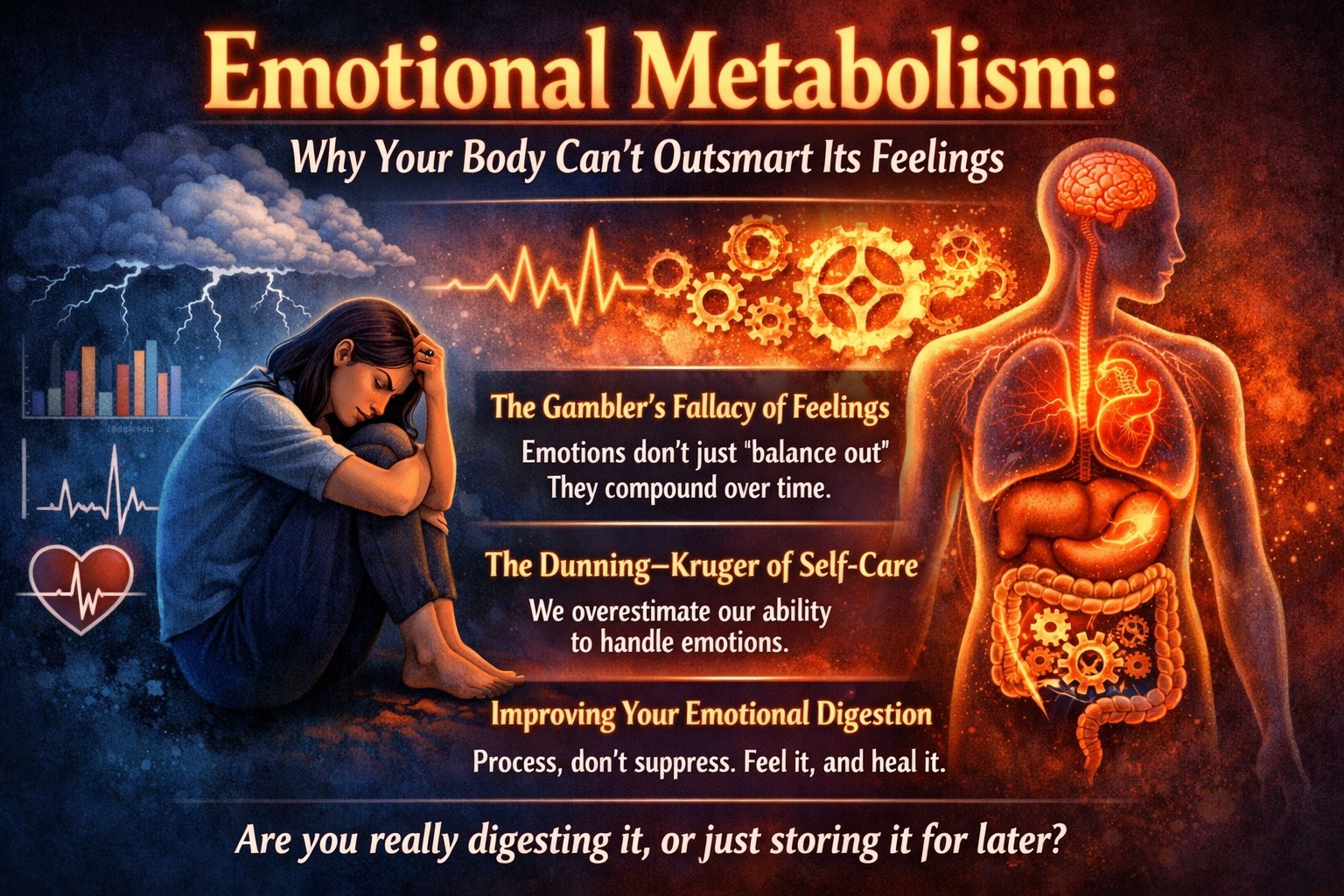
That’s because emotions don’t vanish. They metabolise.
Just like food, every emotion you take in must be digested, absorbed, or stored. This invisible process — your emotional metabolism — is always at work, quietly shaping your body, your mind, and even your future health.
The Gambler’s Fallacy of Feelings
We like to believe emotions balance themselves out.
“I’ve had a rough week, so next week I’m due for calm.”
But emotions don’t flip like coins.
Stress on Monday doesn’t cancel out on Tuesday. Anxiety doesn’t “owe” you serenity after a few days. That belief is the gambler’s fallacy — assuming chance will even the scales.
In reality, emotions compound like debt. Each unprocessed worry collects interest. That’s why one angry encounter can disturb your sleep, sour your morning, and shadow your entire week.
You’ve lived this: you told yourself the storm would pass, yet the thunder stayed in your body long after the clouds were gone.
The Dunning–Kruger of Self-Care
Most of us secretly believe we’re better at handling emotions than others. You’ve thought it too:
“I don’t let things get to me.“
“I know how to cope.”
But notice how often your body disagrees.
The “random” migraine, the stomach upset you call “just something I ate“, the fatigue you dismiss as “a busy day” — these are signs your emotional metabolism is struggling.
This is the Dunning–Kruger effect in self-care:
we overestimate our ability to manage feelings while underestimating their impact. We confuse suppression with mastery. Distraction with digestion. Silence with strength.
And you know this truth: you’ve told yourself you’ve moved on, but a song, a smell, or a memory pulls the emotion back as raw as ever.
The Forer Truth: This Is About You.
You may not realise it, but your body has been metabolising emotions all along:
- Anger that leaves you buzzing yet exhausted.
- Grief that makes you heavy, yet strangely clear.
- Joy that energises you in ways sleep never could.
You read these lines and see yourself in them. That’s the secret: emotional metabolism feels uniquely yours, yet it’s universal. Everyone carries it, silently, daily, in ways both visible and hidden.
The Science Behind the Metaphor
- Stress hormones like cortisol and adrenaline surge under pressure, raising blood sugar and blood pressure.
- Chronic anxiety keeps your body in “fight-or-flight“, exhausting reserves.
- Unprocessed grief or trauma affects digestion, immunity, and even chronic pain.
Your body doesn’t care if you think you’ve “handled it“. It processes emotions anyway — sometimes smoothly, sometimes leaving residue that shows up as symptoms.
How to Improve Your Emotional Digestion
Like food, emotions require thoughtful digestion. You can’t avoid them, but you can metabolise them better:
Chew slowly:
Give emotions time. Journaling, talking, or therapy helps break them down.
Don’t swallow whole:
Suppressing feelings is like swallowing food without chewing — it hurts later.
Balance your plate:
Mix heavy emotions with nourishing practices: exercise, music, prayer, and nature.
Hydrate with mindfulness:
Awareness helps emotions move instead of stagnating.
You’ve done this before, even without naming it. You went for a walk after an argument, called a friend after bad news, or sat quietly with yourself, and you felt lighter. That was emotional metabolism in action.
The Hidden Bill
Here is the truth no gambler can escape: you can’t bluff your body.
Every unprocessed feeling eventually presents a bill — in fatigue, in blood pressure, in immunity, in relationships.
But here is the gift: every metabolised feeling leaves behind nutrients. Anger processed becomes clarity. Grief faced becomes compassion. Joy savoured becomes resilience.
The choice is not whether you metabolise emotions. You already do. The choice is how well.
Closing Reflection
Tomorrow’s strength is built from today’s digestion. The emotions you face today — however heavy, however inconvenient — can either burden or nourish you.
So ask yourself tonight:
Am I really digesting this, or just storing it for later?
Because your emotional metabolism is always working — quietly shaping your health, your energy, and your humanity.







Leave a Reply