
A plain explanation using science, logic, psychology, philosophy, and real medicine
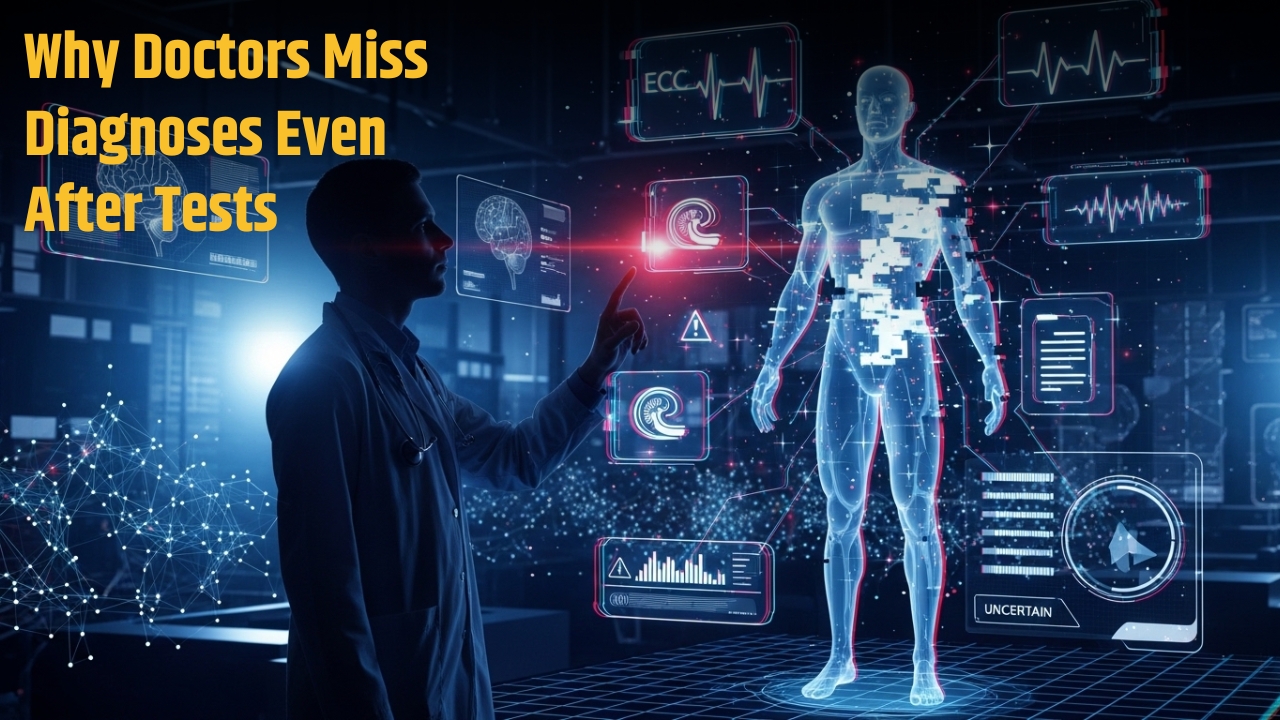
Most people expect diagnosis to follow a simple sequence: feel unwell, see a doctor, get a test, and receive an answer. But real medicine rarely works that way.
Patients sometimes remain undiagnosed for days, weeks, or months. An initial diagnosis gets revised. All the reports come back “normal,” yet the patient is clearly suffering. This confuses patients and frustrates doctors alike.
Why does this happen?
The answer becomes clearer when we examine diagnoses honestly—through science, probability, psychology, logic, and the complicated nature of the human body itself.
1. A test is not the disease.
This is the most important point and the one most often misunderstood.
A blood test, scan, or biopsy is not the disease. It is a clue — an indirect measurement that points toward reality without fully capturing it. A sugar test measures glucose, not “diabetes” in its entirety. A scan shows shapes and densities, not the whole truth of an illness. An ECG records electrical patterns, not the full life of a living heart.
Because tests are clues rather than direct revelations, two things remain possible: a person may have disease even when a test looks normal, and a person may have an abnormal test result without having significant disease. We naturally want certainty. But tests do not create certainty. They reduce uncertainty — which is a different, more modest thing.
2. Disease has a timeline—and early chapters are incomplete.
Many conditions begin quietly. In their early stage, the body may not yet show clear changes detectable by any test. Symptoms at this point are often vague: a persistent tiredness, a feeling that something is wrong, pain that comes and goes, and reports that look normal while the person does not feel normal.
A disease is like a story whose first chapter is still being written. The doctor arrives and finds only scattered pages. The pattern may not become legible until later—which is why follow-up matters so much and why time itself can act as a diagnostic tool.
This is not a failure of medicine. It is the honest nature of how illness unfolds.
3. Medicine is probabilistic, not arithmetic.
People often expect diagnosis to behave like school arithmetic: one symptom plus one test equals one diagnosis. But medicine is closer to probability than certainty.
A doctor is constantly asking, “What is most likely?” What is most dangerous to miss? What fits best with the available evidence? What needs treating now, even without complete proof? This is not careless guesswork. It is disciplined reasoning under uncertainty.
Working with likelihood rather than absolute proof means a first diagnosis may be treated while other possibilities stay in view. It also means a diagnosis may change as new evidence appears — and that change is not always failure. Often, it is honest correction.
4. Symptoms do not belong to single diseases.
A symptom is not a label. Chest pain can come from the heart, the stomach, the muscles, the lungs, anxiety, or the nerves. Fever can arise from infection, autoimmune disease, cancer, a drug reaction, or inflammation. Fatigue can point in dozens of directions.
Symptoms are like words: their meaning depends entirely on context. A doctor must interpret the whole sentence, not just one word in isolation. That requires gathering the full story — the timing, sequence, severity, what makes things better or worse, what else is happening in the body — before the picture begins to cohere.
5. The body is a network, not a machine with one faulty part.
When a machine breaks, you often find a single failed component and replace it. The human body does not work that way. It is living, adaptive, and deeply interconnected.
Diabetes can affect nerves, kidneys, eyes, blood vessels, and immunity all at once. Stress can reshape sleep, gut function, pain perception, and blood pressure simultaneously. A single infection can trigger inflammation, clotting problems, fatigue, confusion, and organ stress at the same time.
This means one disease can produce many symptoms, multiple diseases can converge on a single symptom, and one condition can hide behind another. That layered complexity is one of the central reasons diagnosis is genuinely hard.
6. Every test has limits—and timing changes everything.
No test is perfect. Every test has sensitivity, specificity, false positive rates, false negative rates, machine limitations, observer variation, and timing constraints.
Some tests miss disease in its early phase but perform well in advanced disease. Some are useful for screening but unreliable for confirmation. Some depend entirely on being done at the right moment.
This last point is underappreciated. Some infections are not detectable until days after exposure. Some heart problems appear only during pain. Some hormonal disorders fluctuate. Some neurological conditions show completely normal imaging in early stages. A “normal” test result does not always mean “no disease.” It sometimes only means “not visible at this moment.”
Test results never speak alone. They must be interpreted—with context, timing, and clinical judgment applied—before they mean anything at all.
7. Human beings vary enormously.
Medicine deals in variation. Two people with the same disease may look completely different from one another.
One person presents with classic symptoms; another has only subtle signs. One person tolerates pain quietly; another experiences it as overwhelming. Age, sex, genetics, immune status, weight, previous illness, current medications, cultural context, and anxiety all shape how disease appears. One patient may have multiple overlapping conditions that obscure each other.
A disease does not always read the textbook before entering a patient. It adapts, hides, and sometimes behaves in ways no case series has yet fully described.
8. Diagnosis is detective work, not a lookup table.
Diagnosis is pattern recognition combined with reasoning, not the retrieval of a pre-stored answer. A doctor is continuously trying to connect symptoms, duration, sequence, severity, examination findings, risk factors, test results, and the patient’s response to treatment into a coherent pattern. This is clinical reasoning and it is closer to detective work than data entry.
The detective asks: Which clues matter most? Which might mislead me? What explains the whole picture, not just part of it? What doesn’t fit — and why? When experienced doctors seem to “sense” something before a test confirms it, they are not using intuition in any mystical sense. They are recognizing patterns built from years of careful observation.
9. Psychology shapes diagnosis on both sides of the conversation.
Patients may forget important details, describe the same symptom differently across visits, minimize something out of embarrassment, or fixate on one complaint while overlooking another. None of this reflects dishonesty. It reflects the difficulty of translating felt experience into words, especially under stress or fear.
Doctors are also human. They can be anchored by a first impression that turns out to be wrong. They may unconsciously favor common diagnoses. They can be influenced by time pressure, fatigue, or a recent memorable case. The first explanation can feel so satisfying that it discourages searching for a second.
Modern medicine studies these systematic thinking errors called cognitive biases—seriously and scientifically. Recognizing them is part of practicing well. The goal is not to pretend that bias doesn’t exist but to build habits that counteract it, such as asking, “What else could this be?” even when the obvious answer feels complete.
10. The obvious answer is sometimes wrong.
Logic teaches a humbling lesson: the first explanation is not always the true one.
A cough may be a simple viral infection—or it may be heart failure, asthma, tuberculosis, acid reflux, or a lung tumor. If the first explanation seems common, both doctor and patient may relax too early, and the right answer gets delayed.
This is also why improvement after treatment doesn’t always prove the diagnosis was correct. People can get better because the disease was naturally resolving, because the treatment reduced inflammation without addressing the underlying cause, because symptoms naturally fluctuate, or because a placebo effect provided temporary relief. Response to treatment is useful information — but not proof.
11. “All tests are normal” does not mean nothing is wrong.
Few statements trouble patients more than “Your tests are normal, but you still feel unwell.”
This can happen for several distinct reasons. The right test may not yet have been ordered. The disease may be too early to detect. The abnormality may be functional rather than structural — a problem in how the body’s systems are communicating, not in any tissue that a scan can see. Or the condition may belong to a category that current medical tools still capture imperfectly, such as states involving autonomic imbalance, chronic pain sensitization, or the downstream effects of persistent stress and sleep disruption.
“Normal” rarely means “nothing is wrong.” It more precisely means the current tools have not yet shown a clear structural abnormality. That is a much more limited statement — and an honest one.
12. Diagnosis is a process, not a final stamp.
People imagine diagnosis as a single definitive event—a stamp placed once and kept forever. But many diagnoses are dynamic. They change as disease evolves, as new symptoms surface, as old assumptions fail, as treatment responses reveal something unexpected, and as repeat tests show what early ones could not. A better doctor is not one who never changes a diagnosis.
A better doctor is one who changes their mind honestly when evidence demands it—and who says so clearly, without embarrassment.
13. Why it is hard: the logic of working backwards
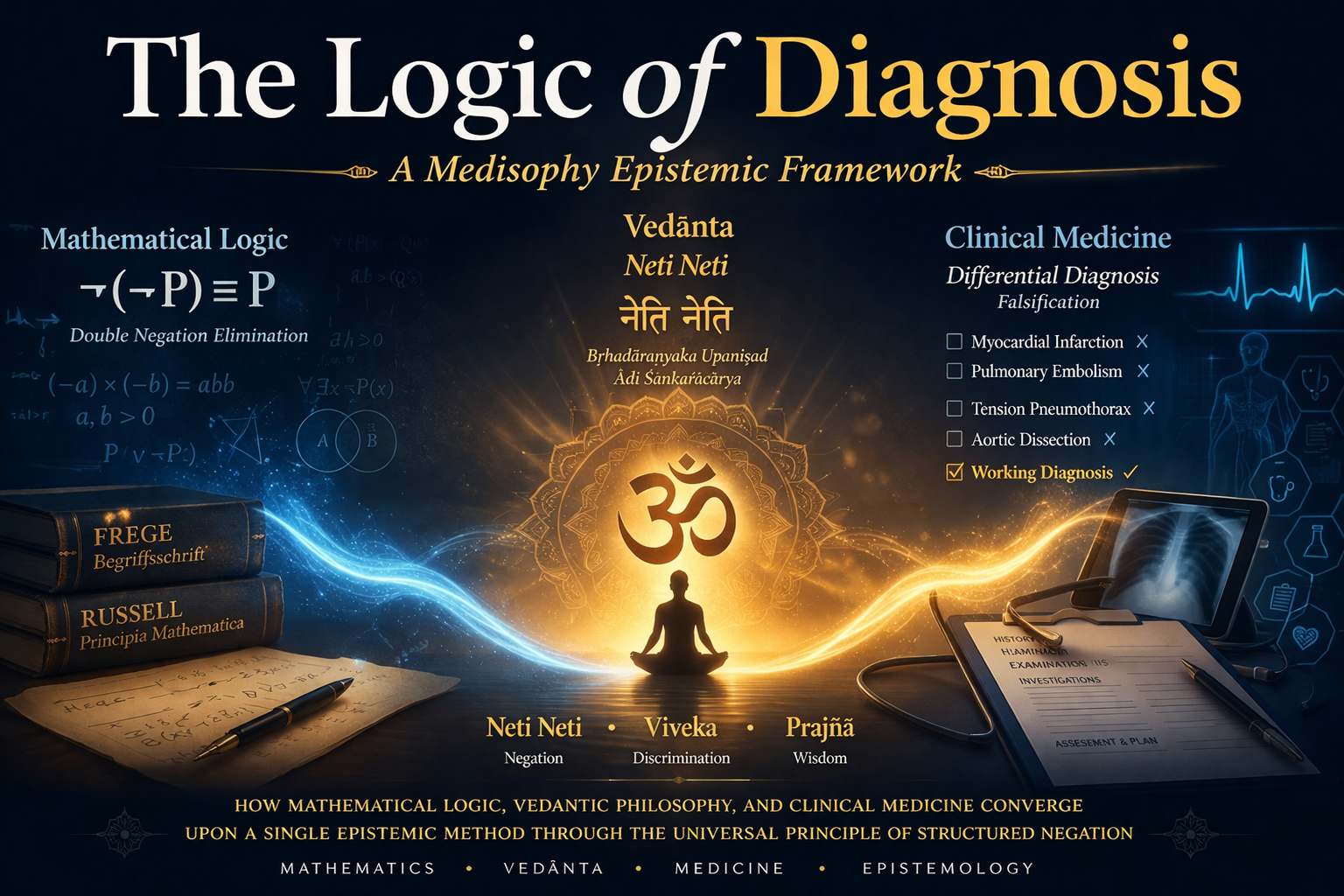
In logical terms, diagnosis requires moving from effects back to causes—from what the patient feels to what is producing those feelings. Many different causes can produce the same effect. That’s what makes it difficult.
It is far easier to move from a known cause to an expected effect. Diagnosis runs in the opposite direction: from visible, outward signs toward a hidden internal cause that must be inferred. The word “infer” matters here. Diagnosis is an act of reasoned inference from incomplete information—not the transcription of an obvious truth.
This is not weakness. It is the actual structure of the problem.
14. What good diagnosis requires — and how patients can help
Good diagnosis requires science, careful observation, attentive listening, pattern recognition, logical discipline, humility, follow-up, and the willingness to revise. It is both technical and deeply human. A purely mechanical doctor misses the story. A purely intuitive doctor misses the evidence. A good doctor works to unite both.
Patients are not passive in this process. They contribute meaningfully by describing symptoms clearly and in sequence, explaining what makes things better or worse, bringing old reports to appointments, reporting new developments honestly, returning for follow-up when things aren’t improving, and telling their doctor when something doesn’t fit.
Diagnosis becomes better when doctor and patient reason through it together.
In summary: Why doctors miss diagnoses even after tests
Tests are clues, not answers. Disease changes over time, and early stages often remain invisible. The body is complex, individual, and interconnected. Many diseases share the same symptoms. Human thinking has systematic biases. Real clinical circumstances are messy. And diagnosis is, at its core, an act of inference under incomplete information.
Doctors do not diagnose disease by reading a perfect answer sheet. They diagnose by reasoning through evidence that is incomplete, changing, and sometimes misleading—under time pressure, with a patient in front of them who is suffering and waiting.
A final thought
When a diagnosis is missed or delayed, patients suffer, and that suffering is real. Medicine must always work to do better—through more careful reasoning, better listening, better follow-up, and greater honesty about uncertainty.
But the path to better diagnosis is not blind faith in more tests. It is clearer thinking. Because the deepest truth of medicine is not that it removes uncertainty. It is that it disciplines itself to think carefully within uncertainty—on behalf of the person sitting across the desk.
Sometimes the problem is not that the doctor didn’t look.
Sometimes the truth was still hiding.

Leave a Reply