

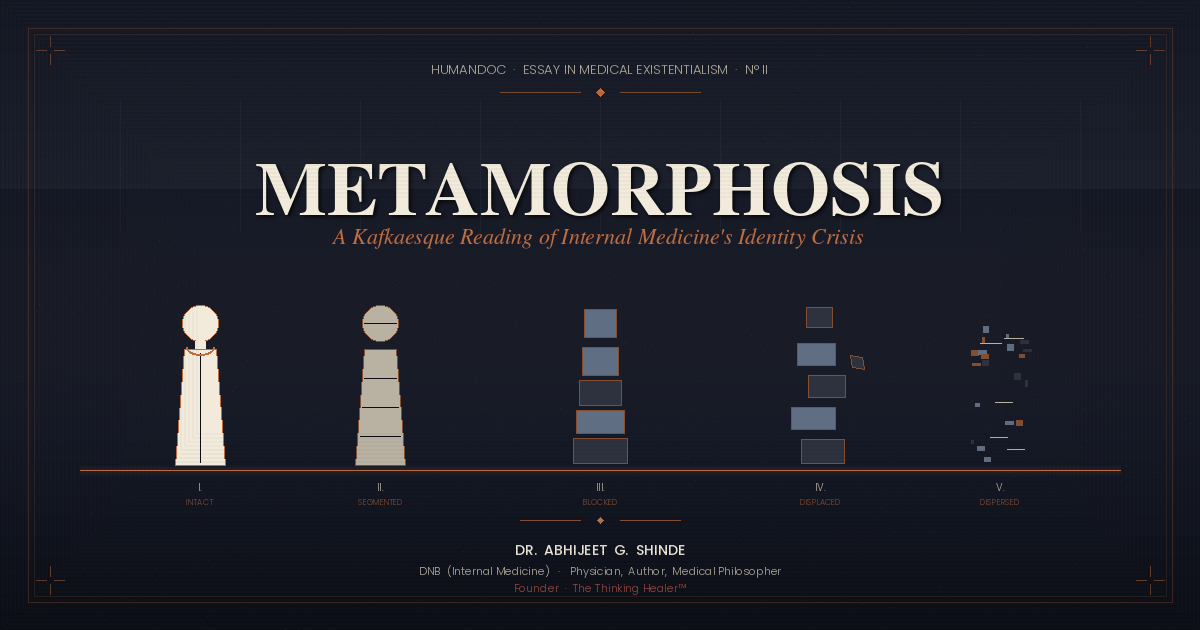
Introduction: The Gregor Samsa of Medicine
Kafka’s Gregor Samsa awakens one morning to discover he has become something unrecognisable—to his family and to himself. The story, though fantastical, is profoundly unsettling: it captures how institutions can quietly deform identity, stripping a person of the role that gave his life meaning.
The modern internist—once envisioned as the physician-scholar who sees the whole person—has undergone a similar metamorphosis. Institutionalisation and the relentless rise of super-specialities have reshaped internal medicine. The healer who once embodied breadth, reasoning, and holistic vision often awakens to find himself transformed into a fragmented specialist, a clerk of protocols, or a cog in the machinery of the hospital.
1. The Internist Before Metamorphosis
Traditionally, internal medicine was the art of synthesis. The internist was defined by three interlocking commitments:
- To gather diverse symptoms into a coherent clinical narrative.
- To balance scientific rigour with careful bedside reasoning.
- To treat not only the organ but the person within whom it fails.
The internist was a thinker, a generalist, and often the moral anchor of the hospital—the physician others turned to when complexity exceeded the boundaries of any single speciality.
2. Institutionalisation: The Bureaucratic Cocoon
Modern healthcare institutions impose structures that progressively narrow this role:
- Protocols and guidelines: Physicians are required to follow rigid pathways, leaving little room for interpretive judgment or individualised care.
- Metrics and audits: Success is measured in compliance rates and throughput, not clinical wisdom or patient outcomes.
- Time pressures: Time-pressured consultations reduce the internist’s role to one of mere efficiency, leaving little space for the reflective reasoning that defines the discipline.
Like Kafka’s protagonist, the institutionalised internist becomes unrecognisable—to patients, to society, and sometimes to himself. What was once a vocation of reflection risks becoming a bureaucratic function.
3. Super-Specialisation: The Fragmented Body
The rise of super-speciality medicine further accelerates this metamorphosis. The patient is no longer seen as a whole but is divided among cardiologists, nephrologists, pulmonologists, and rheumatologists. The internist—whose defining role was integration—now risks marginalisation.
This fragmentation mirrors Gregor Samsa’s fate precisely: once central to his family’s livelihood, he becomes peripheral, sidelined, locked in his room. The internist faces an analogous displacement—reduced from the central thinker of patient care to an “admission clerk” who routes patients to specialists rather than synthesising their care.
4. The Existential Cost
For the internist, this transformation carries a cost that is not merely professional but existential:
- Loss of identity: The pride of being the “doctor’s doctor”—the physician who synthesises what others cannot—is steadily eroded.
- Alienation: Reduced autonomy, constant administrative oversight, and specialist dominance create a genuinely Kafkaesque landscape—one in which the rules multiply while the purpose recedes.
- Moral injury: Physicians feel complicit in a system that reduces patients to component organs and reduces doctors to functionaries. The gap between what medicine should be and what the institution permits becomes a source of sustained distress.
The metamorphosis is not only professional but philosophical—a shift from healer to technician, from vocation to function.
5. Resisting Dehumanisation: The Thinking Healer’s Revolt
Yet the internist need not accept this fate passively. Just as Camus, in The Myth of Sisyphus, urges revolt against the absurd rather than surrender to it, the internist can resist metamorphosis by actively reclaiming core values:
- Diagnostic reasoning: Reclaimed as an intellectual craft, not merely a protocol-driven exercise. The internist who reasons carefully—who generates and tests hypotheses, who holds complexity—offers something no algorithm can replicate.
- Holistic care: Treating the patient as a person whose biography shapes their biology—integrating the social, psychological, and physical dimensions that sub-specialities, by design, must set aside.
- Humanism: The essential counterweight to institutional dehumanisation—preserving the relationship between physician and patient as a moral, not merely transactional, encounter.
- Collaboration without submission: Working alongside specialists while retaining the authority to synthesise, interpret, and advocate for the whole patient—not conceding that synthesis to the system itself.
The future of internal medicine lies not in denying super-specialisation—whose advances are real and vital—but in reasserting the internist’s unique function: synthesis, judgment, and humane care.
Conclusion: Awakening with Clarity
Kafka’s Gregor Samsa could not escape his metamorphosis. The internist, however, still can. By recognising how institutions and super-specialities reshape professional identity, physicians can choose to resist—and perhaps reverse—this dehumanisation.
The challenge is to preserve the thinking healer’s essence: to remain the physician who sees the whole patient, who reasons through complexity that defeats narrower frameworks, and who sustains the human core of medicine even when the institution does not reward it.In a world that fragments and bureaucratises, the true revolt of the internist is to remember what medicine has always been—not a discipline of organs, protocols, or metrics, but an encounter between one human being and another, at the moment of greatest vulnerability.


Leave a Reply