
A Kantian Account of Clinical Reasoning in the Light of Medisophy
Dr. Abhijeet G. Shinde, DNB (Internal Medicine)
Physician, Author, and Medical Philosopher
Founder — Thinking Healer
Abstract. This essay applies Kant’s critical epistemology — particularly the phenomenal/noumenal distinction, the transcendental analytic, and the regulative employment of reason — to the structure of clinical diagnosis. It argues that medical knowledge, like all human knowledge, is irreducibly conditioned: physicians operate within a domain of structured appearances, never gaining unmediated access to disease as it is in itself. Drawing upon the philosophical framework of Medisophy, the essay demonstrates that this Kantian structure is not a deficiency of medicine but its constitutive condition, one that demands epistemic humility, inferential rigor, and a reformed conception of diagnostic truth as asymptotic approximation rather than direct revelation.
Introduction: The Illusion of Direct Knowing
In the ordinary language of clinical practice, diagnosis is habitually figured as an act of discovery — as though the physician, armed with instruments and acumen, reaches through the veil of symptoms to seize disease in its naked actuality. This vocabulary of unmediated access, so pervasive as to pass unexamined, conceals a deeper and more unsettling epistemological reality: the physician never encounters disease directly. What presents itself at the bedside is not disease itself but a structured field of appearances — symptoms, signs, laboratory values, imaging patterns, and patient narratives — each of which is itself already a mediated representation, shaped by the conditions of perception, measurement, and interpretation.
To expose and rigorously analyze this structure is the task of a philosophically informed medicine. The most powerful conceptual architecture available for this purpose is found in the critical philosophy of Immanuel Kant, above all in the Critique of Pure Reason (1781/1787), where Kant prosecuted perhaps the most consequential revolution in the history of epistemology: the demonstration that human knowledge is exhaustively bounded by the conditions of possible experience, and that any aspiration to cognize objects as they are in themselves — independently of those conditions — is destined to lapse into paralogism, antinomy, or idle speculation.
When transposed into the domain of medicine, this insight is genuinely transformative. Clinical reasoning is not the direct apprehension of pathological reality; it is a disciplined interpretation of phenomena under epistemically limiting conditions. The recognition of this structure does not diminish medicine — it ennobles it, demanding of the clinician a form of intellectual integrity that mere technical competence can never supply.
I. The Kantian Framework: Phenomena, Noumena, and the Architecture of Experience
Kant’s theoretical philosophy rests upon a distinction of the utmost importance: the distinction between phenomena — objects as they appear to us, constituted in accordance with the a priori forms of sensibility (space and time) and the pure concepts of the understanding (the categories) — and noumena — things as they are in themselves, entirely independent of the conditions under which they are given to a knowing subject. This distinction is not merely terminological. It marks the absolute boundary of possible human cognition.
In the Transcendental Aesthetic, Kant demonstrates that space and time are not properties of things as they are in themselves, but forms of our sensible intuition — the medium through which outer and inner experience is structured. In the Transcendental Analytic, he shows that the categories of the understanding — unity, causality, substance, and the like — are conditions of the possibility of experience, not features abstracted from it. Together, these structures make experience coherent, unified, and objective — but at a price: they render the thing-in-itself permanently inaccessible. To know an object is always to know it as it appears under these conditions, never as it is apart from them.
“The understanding can intuit nothing, the senses can think nothing. Only through their union can knowledge arise.” — Immanuel Kant, Critique of Pure Reason (A51/B75)
For medicine, this Kantian architecture is not a distant philosophical abstraction. It maps onto clinical reality with remarkable precision. The disease process, in its full ontological depth — its molecular pathogenesis, its systemic ramifications, the precise configuration of cellular dysfunction — is never directly accessible. What the physician encounters is always already mediated: a phenomenal field constituted by the instruments and concepts through which it is disclosed. The noumenon of disease — what disease is independently of all measurement, representation, and interpretation — remains, in the strict Kantian sense, forever beyond cognitive reach.
II. The Phenomenal Character of Clinical Data
Every clinical encounter is, in the most rigorous sense, a phenomenal encounter. The patient does not present with disease itself; the patient presents with disease’s appearances — a structured set of manifestations that are always already filtered through the perceptual, conceptual, and technological apparatus that makes them legible.
Pain is not the tissue injury that causes it, but a complex neurophysiological event further transformed by psychological context, cultural meaning, and linguistic expression. Fever is not infection, but the pyrogenic response to it — a physiological representation of underlying pathology. Laboratory values are not metabolic realities in themselves, but numerical outputs of measurement systems, each carrying its own systematic assumptions, error distributions, and reference intervals derived from population norms that may not apply to the singular patient. Imaging findings are representations at specific wavelengths, resolutions, and contrast parameters — not transparent windows onto anatomical truth. Even histopathology — widely regarded as the epistemic gold standard — involves an act of interpretation: the pathologist applies a learned conceptual schema to a stained section, and the diagnosis that results is as much a product of that schema as of the tissue itself.
It is essential to insist upon this point against naive realism: even our most sophisticated diagnostic technologies do not escape the phenomenal condition. They expand the phenomenal field — they render visible dimensions of pathology that were previously inaccessible — but they do not abolish the gap between appearance and reality. A biomarker is a measurable signal. An imaging sequence is a parametric representation. A genomic profile is a computational interpretation of base-pair sequences. In each case, we are still operating within the domain of phenomena; we are still on the hither side of the noumenon.
III. Diagnosis as Transcendental Inference
If clinical data is irreducibly phenomenal, then diagnosis cannot be perception; it must be inference. And it is a particular form of inference — what we might call, invoking Kant’s apparatus, a transcendental inference: the construction, from the available phenomenal evidence, of the most coherent explanatory hypothesis concerning the underlying condition that, though itself unobservable, is postulated as the necessary ground of the appearances.
This inferential process is structured by several interlocking cognitive operations. Pattern recognition involves the subsumption of observed findings under established diagnostic schemata — the instantiation, in Kantian terms, of empirical concepts in sensible intuition. Probabilistic reasoning assigns degrees of epistemic warrant to competing hypotheses on the basis of base rates, likelihood ratios, and the evidential weight of particular findings. Causal inference constructs a temporally ordered pathophysiological narrative — a sequence of causal states — that can account for the patient’s clinical trajectory. Temporal integration synthesizes observations distributed across time into a unified clinical picture, applying what Kant would recognize as the categories of substance and causality to produce a coherent object of medical knowledge.
The disease itself is never seen. It is posited — inferred as the most coherent and parsimonious explanation of the observed phenomena. This is not a deficiency of medical reasoning but its essential structure. The clinician is, in this respect, engaged in what Kant called the regulative employment of reason: projecting an ideal of systematic unity — the unified disease process — that organizes and gives coherence to the manifold of clinical appearances, even though that unity can never itself be presented in experience.
IV. The Noumenon as Regulative Ideal: Constraint Without Constitution
A misreading of Kant would conclude that, if the noumenon is unknowable, it is therefore clinically irrelevant — an empty philosophical concept with no practical bearing on medical reasoning. This misreading must be firmly corrected. Although the noumenon cannot be known, it plays an indispensable regulative function: it represents the underlying reality that constrains and corrects our interpretations, operating as an ideal limit toward which inquiry asymptotically tends.
Kant distinguished between the constitutive and the regulative employment of concepts and principles. A constitutive use applies a concept to an object so as to determine it as a possible object of experience. A regulative use employs an idea — which can never be fully instantiated in experience — as a heuristic principle that guides inquiry toward systematic completeness without claiming to constitute an actual object of cognition. The noumenon of disease functions regulatively: it serves as the ideal that orients diagnostic reasoning without being itself an object of direct knowledge.
This regulative function has profound consequences for clinical practice. Because we are always approximating an inaccessible reality rather than constituting a fully determined object, all diagnoses are inherently provisional. They are not errors awaiting correction so much as progressive refinements of an approximation that can always be improved but never completed. Revision is not the exception but the rule — not a sign of clinical failure but of intellectual integrity. Uncertainty is not a temporary condition to be resolved by the acquisition of more data; it is an irreducible feature of the epistemic situation, inscribed in the very structure of clinical knowledge by the noumenal condition of its object.
V. Scientific Progress and the Expanding Phenomenal Field
The history of medicine is, among other things, the history of an expanding phenomenal field. Each successive advance in diagnostic technology — from physical examination to auscultation, from radiography to CT and MRI, from serology to molecular diagnostics and genomics — has rendered accessible dimensions of pathology that were previously opaque. This expansion is the genuine achievement of scientific medicine, and its significance should not be minimized.
Yet it is essential to recognize, in Kantian terms, the precise character of this achievement. Scientific progress does not breach the phenomenal boundary; it enriches the phenomenal domain. Each new technology generates new representations, new appearances, new mediated images of the underlying reality. The phenomenal field grows more detailed, more precise, more multi-dimensional — but it remains phenomenal. The noumenon retreats, as it were, to a smaller and smaller residuum as phenomena multiply, but it never disappears.
This means that the epistemological structure of clinical reasoning remains constant across all levels of technological sophistication. The most advanced genomic diagnostician and the most traditional bedside clinician occupy, in this crucial respect, the same epistemic position: both reason from phenomena toward a noumenon that can never be directly grasped. The difference is in the richness and precision of their phenomenal data, not in the fundamental character of their knowledge.
VI. Differential Diagnosis and the Problem of Underdetermination
One of the most practically important corollaries of the Kantian structure of clinical knowledge is the problem of underdetermination: a given set of phenomena is, in principle, compatible with multiple distinct underlying realities. The same symptom complex — fever, arthralgia, rash — may arise from systemic lupus erythematosus, viral infection, drug hypersensitivity, or seronegative arthritis. The phenomena underdetermine the noumenon; the appearances do not uniquely specify their cause.
Differential diagnosis, far from being merely a pragmatic exercise in clinical navigation, is the institutionalized recognition of this epistemological truth. The clinician who maintains a differential diagnosis is not a clinician who does not know the answer; the clinician is a clinician who correctly appreciates that the phenomenal evidence, taken by itself, is insufficient to uniquely determine the underlying diagnosis, and who acts accordingly — holding multiple hypotheses in suspension, weighted by prior probability and evidential support, until further phenomena permit a more confident discrimination.
This is precisely the posture that Kantian epistemology demands: intellectual humility before the underdetermination of phenomena, combined with the practical imperative to act on the best available approximation rather than waiting for a certainty that will never arrive.
VII. Cognitive Architecture and the Sources of Diagnostic Error
The Kantian analysis illuminates not only the structure of correct clinical reasoning but also the structure of its failure. Diagnostic errors arise not merely from ignorance — from the absence of relevant information — but from the cognitive architecture through which information is processed. The very structures that make clinical knowledge possible also introduce systematic vulnerabilities.
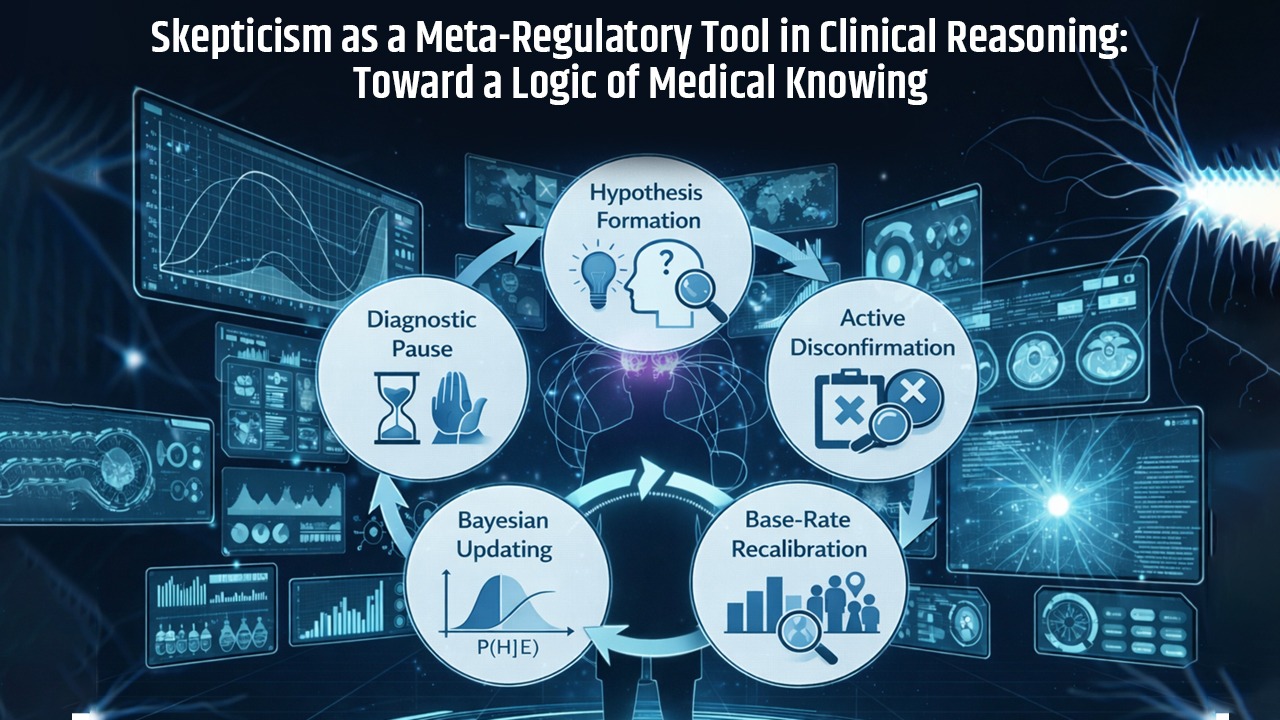
Anchoring bias — the tendency to fix upon an initial hypothesis and resist revision in the face of contrary evidence — reflects the inertia of the schematic frameworks through which phenomena are interpreted. Once a particular diagnostic category has been applied, it tends to function as a constitutive rather than a regulative principle: it ceases to guide inquiry and begins instead to determine the object, distorting perception of anomalous findings and suppressing attention to disconfirming evidence. Availability bias represents the distortion of probabilistic reasoning by the relative accessibility of certain diagnostic categories in memory — a failure of the reflective judgment that should calibrate prior probabilities against actual base rates. Premature closure instantiates, at the level of clinical practice, what Kant identified as the fundamental temptation of speculative reason: the imposition of a false closure upon an inquiry that, by its nature, must remain open.
These biases are not, on the Kantian account, adventitious failures that might be eliminated by sufficiently rigorous training. They are expressions of the constitutive structures of cognition itself — structures that simultaneously enable understanding and constrain it. To recognize this is to understand why error reduction in clinical medicine requires not merely the acquisition of more knowledge, but the cultivation of a meta-cognitive discipline: a trained capacity to monitor one’s own cognitive operations from a critical standpoint, recognizing when constitutive principles are masquerading as regulative ones, when categories are being overextended beyond their proper domain.
VIII. The Necessity of Judgment: Schematism and the Singular Case
Kant’s account of judgment — the faculty by which general concepts are applied to particular cases — is among the most subtle and clinically consequential elements of his critical philosophy. In the Critique of Pure Reason, Kant argues that the application of a category to an intuition requires a mediating term, which he calls the schema: a rule for the temporal determination of the intuition that makes it fit to fall under the concept. No mechanical rule can itself dictate its own application; at some point, the application of rules requires the exercise of a judgment that is not itself rule-governed.
In clinical practice, this manifests as the irreducible role of the experienced clinician’s judgment in translating population-level evidence into individual patient care. Evidence-based medicine provides probabilistic claims derived from study populations; the patient before the physician is a singular individual whose relevant characteristics may align only partially, or not at all, with the population from which those probabilities were derived. The application of evidential generalizations to the singular case requires exactly the kind of judgment Kant describes: a faculty that cannot be taught by rule but only cultivated through experience, reflection, and intellectual discipline.
This is not an argument against evidence-based medicine; it is an argument for its proper philosophical grounding. The evidence does not speak for itself. It requires a physician who, through the exercise of cultivated judgment, can determine what the evidence means for this patient, in this context, at this moment — a physician whose reasoning integrates probability, context, consequence, and the values of the particular human being in whose care they are engaged.
IX. Medisophy: Philosophical Medicine as Critical Practice
Medisophy — a philosophical framework for the integration of scientific rigor and humanistic wisdom in medical reasoning — finds in Kantian epistemology its most precise philosophical articulation. Within the framework of Medisophy, diagnosis can be defined with exactitude:
Diagnosis is a structured synthesis of phenomenal evidence, conducted under the regulative idea of an underlying noumenal reality, aimed at the most defensible approximation of a truth that can never be fully possessed.
This definition captures several crucial features that conventional accounts of diagnosis tend to obscure. First, it acknowledges the irreducibly constructed character of diagnostic knowledge: phenomena must be synthesized, organized, and interpreted; they do not constitute a diagnosis by themselves. Second, it preserves the realist intuition that diagnostic reasoning is answerable to an objective reality — the regulative idea of the noumenon ensures that clinical reasoning is not merely a creative act of narrative construction but a truth-directed inquiry constrained by the resistance of appearances. Third, it inscribes provisionality into the very definition of diagnosis: approximation entails the permanent possibility of better approximation; the diagnostic conclusion is never final, only currently best.
Medisophy thus transforms the practice of medicine from a technical discipline concerned with the correct application of algorithms to a critical discipline concerned with the responsible navigation of irreducible epistemic limitation — a discipline that integrates the rigor of science, the reflectiveness of philosophy, and the wisdom that can only be gained through sustained engagement with the clinical encounter in all its complexity.
X. Ethical Implications: Knowledge, Humility, and the Patient as End
The Kantian epistemology of clinical diagnosis is not without ethical significance. Kant’s moral philosophy, as developed in the Groundwork of the Metaphysics of Morals and the Critique of Practical Reason, insists upon the unconditional dignity of rational persons, who must always be treated as ends in themselves and never merely as means. This imperative is directly implicated by the epistemological analysis developed in the preceding sections.
To recognize that diagnosis is approximation — that the patient’s condition, in its full reality, exceeds any diagnostic category we can impose upon it — is to recognize that the patient as a person exceeds our knowledge of the patient as a case. The clinical encounter involves a human being whose inner life, values, suffering, and meaning cannot be fully captured by any diagnostic schema, however sophisticated. Epistemic humility before the noumenon of disease is simultaneously ethical humility before the irreducible dignity of the person who bears it.
This has concrete consequences for clinical practice. It demands transparency about diagnostic uncertainty rather than false confidence designed to reassure. It requires genuine engagement with the patient’s own account of their condition — an account that may disclose phenomenal evidence inaccessible to any instrument. It insists upon the continuous revisability of diagnostic conclusions in the light of new information, including information provided by the patient’s own experience of their illness. And it resists the reification of diagnostic categories — the treatment of a complex human being as though they were simply the instantiation of a disease — which is both epistemologically naive and ethically objectionable.
Medicine becomes, on this account, not merely a technical practice but a philosophical and ethical one: a practice that takes seriously both the power and the limits of human knowledge, and that honors, in its very structure, the dignity of those who seek its care.
Conclusion: The Discipline of Epistemic Responsibility
Kant’s critical philosophy bequeathed to subsequent thought a permanently discomforting insight: that the knowing subject stands not at the transparent center of a fully legible world but at the bounded edge of a phenomenal domain, forever reaching toward a reality that recedes as it approaches. This insight was unsettling to the ambitions of speculative metaphysics. It is equally unsettling to the ambitions of a medicine that imagines itself to be in the business of directly revealing pathological truth.
Diagnosis is not the revelation of truth but a disciplined approximation of it — an approximation that is always conditioned, always provisional, and always answerable to a reality that exceeds its grasp. This is not a counsel of despair. It is a call to intellectual integrity. The clinician who understands the phenomenal structure of clinical knowledge is better equipped to maintain appropriate uncertainty, to revise conclusions in the light of new evidence, to resist the cognitive biases that masquerade as insight, and to engage the singular patient — whose reality can never be fully captured by any diagnostic category — with the respect and attentiveness that genuine knowledge demands.
Medisophy, as a philosophical practice of medicine, takes this Kantian inheritance seriously. It does not promise the physician access to truth unmediated by the conditions of experience. It promises something more valuable: the conceptual clarity, the epistemic discipline, and the humane orientation needed to navigate wisely at the edge of knowledge — which is, always and necessarily, the only place where clinical medicine occurs.
Closing Reflection. Clinical reasoning does not unveil reality in its fullness. It orders appearances responsibly under the discipline of an unknowable real — and in so doing, performs the highest intellectual and moral task available to a finite knowing being: the courageous pursuit of truth in full acknowledgment of the conditions that make such pursuit simultaneously necessary and forever incomplete.
Select Primary References
Kant, Immanuel. Critique of Pure Reason. Translated by Norman Kemp Smith. Palgrave Macmillan, 1929. [Original: Kritik der reinen Vernunft, 1781/1787]
Kant, Immanuel. Groundwork of the Metaphysics of Morals. Translated by Mary Gregor. Cambridge University Press, 1997. [Original: Grundlegung zur Metaphysik der Sitten, 1785]
Kant, Immanuel. Critique of Judgment. Translated by Werner Pluhar. Hackett, 1987. [Original: Kritik der Urteilskraft, 1790]
Cassirer, Ernst. The Philosophy of the Enlightenment. Princeton University Press, 1951.
Foucault, Michel. The Birth of the Clinic: An Archaeology of Medical Perception. Vintage Books, 1994.
Groopman, Jerome. How Doctors Think. Houghton Mifflin, 2007.
Reiss, Julian, and Jan Sprenger. “Scientific Objectivity.” Stanford Encyclopedia of Philosophy, 2017. Shinde, Abhijeet G. Medisophy: A Philosophical Framework for Clinical Medicine. Thinking Healer Publications.



Leave a Reply