
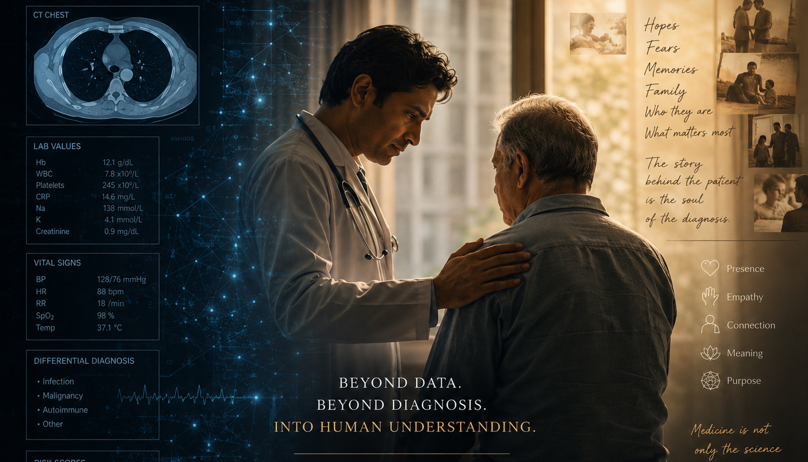
A machine can be right about a patient without understanding them.
This is not a criticism of machines. It is a precise observation about the nature of what they do – and it opens the most important question clinical medicine has not yet fully answered:
What is this understanding that being right does not achieve, and why does its absence leave the patient, walking out with an accurate diagnosis and an evidence-based prescription, feeling that something essential did not happen?
Medicine calls this gap the art of practice, then files it under soft skills, and moves on.
AI has made it impossible to move on.
Because when the machine assumes the diagnostic functions that once required a physician’s full attention, what is left – the residue, the remainder, the thing the algorithm cannot reach – turns out to be not peripheral but central.
Not the decoration on medicine but its load-bearing structure.
And we are discovering, perhaps too late for comfort, that we have no good language for it, no curriculum for it, and no protection for it, because we have never had to name it before.
Its name is the Human Operating System.
And understanding what it actually does- biologically, clinically, philosophically – is the defining task of this moment in medicine.
The Mechanism of Understanding
Understanding between two human beings is not what medicine has usually meant by empathy.
Not feeling sorry. Not imagining how you would feel in someone else’s situation.
Something more specific, stranger, and more biologically real:
The partial activation, in your own nervous system, of what the other person is experiencing.
The neural circuits that encode your own fear, your own pain, your own uncertainty do not stay quiet when you witness these states in another person. They fire – partially, incompletely, but measurably.
The human nervous system was built, across millions of years of social evolution, to be porous in precisely this way: to be, in some biological fraction, affected by what it witnesses.
Understanding as a Neurobiological Event
This is the mechanism of clinical understanding.
Not a metaphor.
A measurable neurobiological event.
What it produces in the physician is something that has no name in the clinical literature, though it is the most clinically significant thing that happens in a consultation:
A partial inhabitation of the patient’s situation.
Not the full weight of it – the physician returns home intact – but enough to generate a felt sense of what it might be like to be this person, carrying this history, arriving with this particular disruption of their particular life.
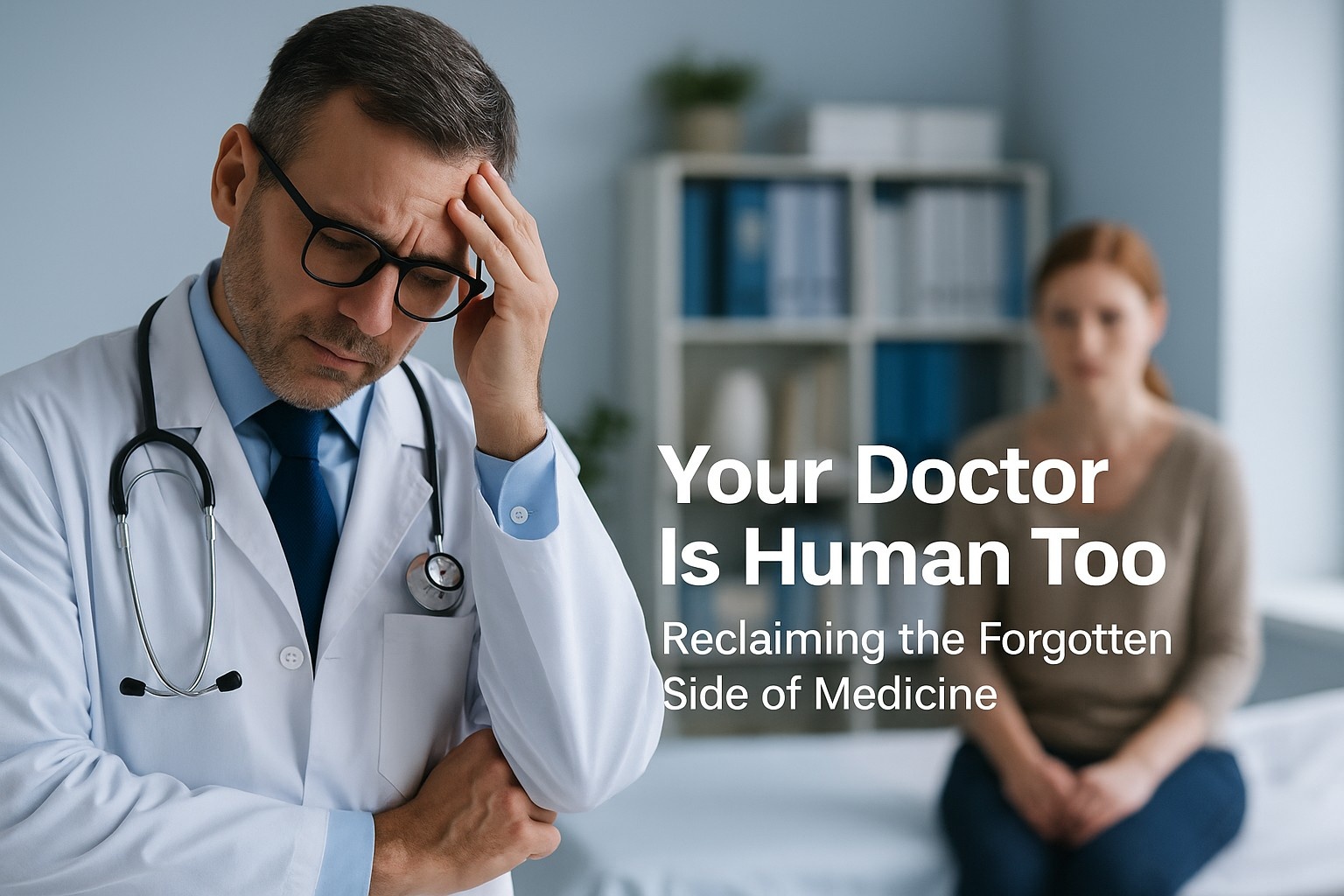
The physician who takes a history and is genuinely changed by what they hear has not had an emotional reaction requiring professional management.
They have understood something.
The change is the understanding.
They are inseparable.
Why Experience Creates More Than Knowledge
This is why experience in clinical medicine produces something beyond knowledge accumulation.
Every encounter that genuinely changes the physician – not just instructs them, but leaves a residue – deepens the instrument.
The physician who:
- Pauses at a bedside without being able to say why
- Asks the question they had not prepared
- Senses that the story does not add up despite a risk score that says otherwise
…is drawing on a library of felt experience that no dataset contains.
It was built not by processing records but by being present, again and again, at the place where biological fact meets human meaning- and being altered by what was found there.
An AI system trained on a million clinical records has processed a million cases.
It has not been changed by one.
When the Relationship Is the Treatment
The gap between a physician who processes and a physician who resonates shows up in the body of the patient.
The quality of the physician-patient relationship – specifically the degree to which the patient feels genuinely received, not merely accurately assessed – independently predicts:
- Medication adherence
- Honest symptom disclosure
- Recovery rates
- Willingness to return for follow-up
The effect size rivals the specific treatment modality in many conditions.
This is not a finding at the margins of clinical evidence.
It is one of the most replicated phenomena in medicine, sitting largely unintegrated into the way medicine trains its physicians or designs its systems.
The Biology of Trust
The mechanism is the placebo response – a term that continues to be misunderstood as a statistical nuisance to be controlled for.
In reality, it is one of medicine’s most revealing phenomena.
What activates it is not a pill but a relationship:
The patient’s felt experience of being in the care of someone who is genuinely with them.
This activates endogenous physiological systems, including:
- Opioid pathways
- Autonomic regulation
- Immune modulation
Through the specific biology of trust.
The relationship does not deliver the treatment.
In a physiologically precise sense:
The relationship is treatment.
Presence Cannot Be Simulated
For this to work, the physician must be genuinely present- which means they must be capable of being affected.
Their nervous system must resonate with the patient’s.
They must carry into the room the implicit message that only a mortal being can carry:
I know something, in my own body, about what it costs to be here. I am not processing you from a safe distance. I am with you.
No algorithm carries this message.
Not because it lacks sophisticated language generation.
Because the message is not transmitted through words.
It is transmitted through the presence of a being that can be changed.
And the patient’s nervous system- older and more precise than any conscious evaluation – registers the difference between resonance and simulation.
The Language Only Life Can Teach
Translation is the other thing the physician does that has no algorithmic equivalent.
And it may be the more invisible of the two.
Every patient arrives living simultaneously in two entirely different orders of reality.
Two Worlds Every Patient Lives In
The Biological World
The world of:
- Creatinine
- HbA1c
- Ejection fractions
- Clinical trajectories
- Evidence-based responses
AI reads this world with increasing accuracy and speed, and we should be glad.
The Human World
A world organised around:
- Meaning
- Significance
- Identity
- Relationships
- The shape of a life
The same finding lands in entirely different human worlds depending on whose life it enters.
The biology may be identical.
The illness experience is entirely singular.
Disease vs. Illness
Disease
Lives in the biological world.
Illness
Lives in the human world.
It is the fear-saturated, meaning-disrupting, future-reorganising experience of receiving medical information.
Medicine happens in both worlds simultaneously.
The Physician as Translator
The physician translates between these worlds in real time.
They:
- Receive biological information and render it into the currency of the patient’s life
- Receive information from the patient’s human world and allow it to shape clinical reasoning
This requires native fluency in the second language.
And that fluency is not acquired from clinical training.
It is acquired from life itself:
- Having been afraid
- Having lost things
- Knowing what it costs to have your body stop cooperating with your plans
- Encountering the limits of control
No system trained on clinical data becomes fluent in this language.
The vocabulary is not medical.
It is human.
And it can only be learned by living.
Vulnerability Is the Operating Condition
Vulnerability is the word that has been missing from this conversation.
The physician’s capacity to:
- Be changed by a patient
- Resonate
- Partially inhabit another person’s experience
- Translate
- Witness
…rests entirely on vulnerability.
Why Vulnerability Matters
The physician:
- Can be affected
- Can be wrong and know it matters
- Can be moved by suffering that is not theirs
- Carries embodied knowledge of uncertainty and fear
This vulnerability is not a clinical liability.
It is the operating condition of the Human OS.
The Machine’s Advantage—and Limitation
The machine is not vulnerable.
That is its advantage.
It:
- Does not fatigue
- Does not anchor on the morning’s worst case
- Does not bring yesterday’s grief into today’s judgment
For pattern recognition, immunity to being affected is a feature.
But for understanding a suffering person, it is precisely the limitation.
The machine can be right without understanding because understanding requires vulnerability.
The Human OS runs on this vulnerability.
It cannot run without it.
The Erosion That Leaves No Error Code
The deepest threat of the AI era is not replacement.
It is the slow erosion of the physician’s capacity to be affected.
The Risk of Deferral
When algorithms absorb diagnostic reasoning, physicians gradually begin to defer.
Examples include:
- Checking the risk score before thinking
- Accepting the differential before examining
- Explaining the algorithm’s output instead of forming independent judgment
This is not weakness.
It is the predictable erosion of a capacity that the system has stopped asking for.
Why the Weight Matters
It is the weight that builds the instrument.
The physician who bears the full moral gravity of a clinical judgment reasons differently than one who has offloaded that gravity to a system.
The following are not inefficiencies:
- Genuine uncertainty
- Resistance of a case that does not fit
- Clinical intuition that contradicts probability estimates
They are signs that the Human OS is running.
When the OS degrades, patients may still receive accurate diagnoses.
But they receive them from physicians who are:
- Slightly less present
- Slightly less changed by what they witness
- Slightly less fluent in the human world
The degradation appears in no quality metric.
It appears only in the patient who leaves feeling that something essential did not happen.
What AI Actually Releases
AI in clinical medicine is not a threat to the Human OS.
It is, if medicine receives it correctly, the greatest opportunity the Human OS has ever had.
Every hour the algorithm spends:
- Reading scans
- Generating differentials
- Calculating risk
…returns time and attention to the physician.
And time and attention are the precise conditions under which the Human OS operates.
What Physicians Can Do With That Time
- Be genuinely present
- Hear the story behind the complaint
- Notice what the body communicates beyond words
- Hold uncertainty alongside the patient
The physician of the AI era does not need to outperform the algorithm.
They need to become more fully, more deliberately, more irreducibly themselves.
A being capable of:
- Being changed
- Translating between worlds
- Understanding through resonance rather than computation
The machine handles what machines do.
The physician attends to what only the Human OS can reach.
What Medicine Must Protect
Medicine must understand the Human OS clearly enough to:
- Protect it
- Cultivate it
- Invest in it deliberately
This means:
- Narrative competence must be assessed as rigorously as pharmacology
- The capacity to be genuinely changed by a patient must be treated as a clinical skill
- Time for presence in consultation must be protected as a clinical necessity
The Ground Beneath Everything
The physician will die.
Not as a professional hazard.
Not as an abstract acknowledgment.
But as the lived ground of everything they bring into the room.
The patient facing a serious diagnosis is confronting:
- The future they planned
- The body they trusted
- The time they thought they had
What they need is not only technical guidance.
They need accompaniment.
A being willing to stand alongside them without flinching.
Shared Vulnerability
The physician who can genuinely accompany rather than merely attend can do so because they know, in their own body, what it costs to face mortality.
The shared vulnerability is:
- Unstated
- Felt
- Biologically real
And it is what transforms the encounter from a transaction into something more.
What the Human OS Ultimately Is
The Human OS is:
The cognitive, moral, and biological architecture of a mortal being who has chosen, again and again, to be fully present with other mortal beings in the hardest passages of their lives.
It cannot be downloaded.
It cannot be trained from data.
It can only be grown.
Slowly.
Through the accumulated weight of:
- Being present with suffering
- Being changed by it
- Carrying those changes forward
In the era of intelligent machines, the most sophisticated instrument in clinical medicine is still the one that walks into the room.
Not because it knows more.
Because it can be broken by what it finds there – and chooses to enter anyway.
The Thinking Healer™
Where rigorous thinking and genuine clinical presence are not opposites but the same thing.
About the Author
Dr. Abhijeet G. Shinde, DNB Internal Medicine
Practices and writes on the human dimensions of medicine in the age of intelligent machines.

Leave a Reply