
Abstract
Clinical medicine is often taught as if diagnosis must precede action with full confidence. Yet real practice rarely offers such certainty. Patients deteriorate before investigations return. Diseases overlap. Tests mislead. The physician must frequently act before the diagnosis is finally secured — and doing so responsibly requires something that medical training seldom explicitly cultivates: epistemic courage.
This essay argues that paralysis in the face of diagnostic uncertainty is not the appropriate expression of intellectual humility — it is a correctable category error. Clinical reasoning operates at two distinct registers: first-order action (what the clinician must do) and second-order epistemic orientation (how the clinician holds the conclusion motivating that action). Epistemic humility belongs to the second register. When trainees misplace it in the first, hesitation results. The appropriate response to irreducible uncertainty is neither naïve realism nor clinical inaction, but warranted provisional action: decisive intervention when evidence crosses a practical threshold, combined with an explicit commitment to revise as the patient’s evolving reality demands.
Drawing on Kantian epistemology, Aristotelian phronesis, Peircean abductive logic, clinical threshold theory, and models of professional skill acquisition, the essay proposes three educational models: the Dual-Register Competency Matrix, the Asymptotic Inquiry Cycle, and the Epistemic Courage Developmental Model. Together they offer a practical framework for teaching clinicians to act responsibly under uncertainty — without pretending that uncertainty has been resolved.
Introduction: From the Edge of Knowledge to the Demand of Action
A Continuation of the Medisophy Inquiry
In ‘Diagnosis at the Edge of Knowledge’, the Medisophy framework established a conclusion that is, once fully absorbed, genuinely disorienting: the physician never encounters disease. Not directly. Not even with the most sophisticated instruments the modern clinic deploys. What presents at the bedside is always and only a phenomenal field — structured appearances shaped by the conditions of perception, measurement, language, and interpretation — while the disease itself, in the full depth of its biological reality, remains what Kant called the noumenon: the thing as it is in itself, forever beyond the reach of any finite knowing subject.
This is not a limitation peculiar to medicine, nor a deficiency that better technology will someday repair. It is the constitutive condition of all human knowledge. The physician who reads a chest radiograph does not see the patient’s lung; they see a parametric reconstruction of tissue density interpreted through a learned perceptual schema. The elevated CRP does not name infection; it names a non-specific acute-phase response whose significance must be inferred in context. At every level, the phenomenal condition holds. The noumenon of disease recedes as inquiry advances but never disappears.
The earlier Medisophy essay argued that this Kantian structure is not medicine’s failure but its intellectual integrity: to acknowledge it is to practise a form of epistemic honesty that naïve realism — the belief that a diagnosis simply names reality as it is — systematically forecloses. A diagnosis, properly understood, is a disciplined approximation: a structured inference from available appearances toward an underlying reality that can never be fully possessed, oriented by a regulative ideal of truth and constrained at every step by the resistance of phenomena. Diagnosis tends asymptotically toward truth without ever arriving.
This conclusion demands nothing less than a transformed conception of what clinical knowledge is and what it asks of those who exercise it. And yet it immediately generates a problem that the earlier inquiry left unresolved: a problem not philosophical but acutely practical, and at its most acute in the formation of clinicians.
The problem runs as follows. A trainee who genuinely internalises the phenomenal/noumenal distinction — who truly understands that the noumenon of disease lies beyond direct cognitive grasp, that all diagnoses are approximations, that certainty is constitutively unavailable — faces a moment of profound intellectual disorientation. The textbook world, in which diseases present with their characteristic features and diagnoses follow from pattern recognition like theorems from axioms, gives way to a more vertiginous reality: a world of overlapping signs, probabilistic reasoning, underdetermined evidence, and perpetually revisable conclusions. And in that moment, the philosophically gifted trainee is in danger of drawing precisely the wrong practical conclusion.
The reasoning runs implicitly but powerfully: because the noumenon of disease is beyond my grasp, because my diagnosis is an approximation rather than a revelation, because certainty is constitutively unavailable to me — I should not act with confidence. To act decisively on a provisional conclusion is to overclaim; to project a certainty I do not possess; to mistake the phenomenal map for the noumenal territory.
This reasoning is, in its philosophical grammar, internally coherent. It is also, in its clinical consequences, catastrophic. The patient in distributive shock, whose blood pressure is falling and whose lactate is rising, cannot wait for a certainty that the structure of clinical knowledge makes constitutively unavailable. The physician who has understood Kant perfectly and acts on that understanding by withholding intervention pending further phenomenal resolution has not achieved philosophical maturity. They have produced epistemic paralysis — and transformed a genuine intellectual insight into an instrument of avoidable harm.
The answer proposed here is neither the suppression of epistemic humility in service of confident action, nor its preservation at the cost of clinical effectiveness. Both are failures — the first a return to naïve realism, the second a category error dressed in philosophical vocabulary. The answer lies in a distinction that is, once made explicit, self-evidently correct, but which medical education persistently fails to articulate.
Clinical reasoning operates at two categorically distinct registers, and the confusion between them is the precise mechanism by which philosophical insight generates clinical paralysis. The first is the register of action: what the clinician must do now, for this patient, given the available evidence and the urgency of the situation. At this register, decisiveness is not a philosophical error but a moral imperative. The second is the register of epistemic orientation: how the clinician holds the conclusion that motivates action — with what degree of calibrated confidence, what awareness of its provisional character, what explicit commitment to revision. This register is where epistemic humility properly lives. It is the posture of the mind, not the movement of the hand.
These two registers are not competing but complementary. The provisional quality of the diagnosis lives at the second level. The antibiotic going up lives at the first. To allow the appropriate epistemic humility of the second register to generate hesitation at the first is the category error that produces the clinician who has understood philosophy too well and medicine not yet well enough to see how they are related.
The concept this essay proposes to bridge them is warranted provisional action: the clinical capacity to act decisively when available evidence crosses a practical threshold for intervention, while continuing to hold the working diagnosis as revisable in light of new phenomenal evidence. Warranted provisional action is the precise clinical expression of what Aristotle called phronesis — practical wisdom — applied to the epistemic conditions that the Medisophy framework has made explicit. The physician who practises it does not say: I am certain, therefore I act. Nor: I am uncertain, therefore I wait. The mature clinician says: I am not certain, and I will never be. But the phenomenal evidence before me warrants action now, and I will act, monitor, and revise without shame if reality demands it.
This is not a compromise between epistemic rigour and clinical necessity. It is their integration. And the name for that integration is epistemic courage: the disciplined capacity to act responsibly within irreducible uncertainty, not by pretending that uncertainty has been resolved, but by refusing to allow it to become an excuse for the suspension of moral and clinical responsibility.
‘Diagnosis at the Edge of Knowledge’ established where medicine occurs. This essay asks what it means to act there. The answer — warranted provisional action, grounded in epistemic courage, structured by the Medisophy framework — is what the pages that follow attempt to articulate with the precision that both clinical practice and philosophical integrity require.
1. The Clinical Moment Where Medicine Truly Begins
A patient arrives in haemodynamic compromise at 3 AM. The monitor is alarming. SpO&sub2; is falling on room air. The blood culture is pending. The imaging has not yet returned. The family is in the corridor. The registrar is three other places simultaneously. The diagnosis is probable; it is not certain. It may never be certain in the way a mathematical proof or a controlled experiment achieves certainty. And yet the patient’s survival may depend entirely on what is decided in the next four minutes.
Septic shock? Adrenal insufficiency? Obstructive shock from a pulmonary embolism? Hypovolaemic shock from occult haemorrhage? Cardiogenic collapse from a silent myocardial infarction? Drug reaction? Several of these simultaneously? Something that has not yet been named in the differential?
The clinician stands before this situation with incomplete knowledge and absolute responsibility. This is not a pathological or aberrant clinical scenario. This is the normal structure of acute medicine. Diagnosis is not first secured and action subsequently taken; action is taken within and constitutive of the diagnostic process. Medicine does not begin when certainty arrives. Medicine begins where certainty never fully arrives, and action is demanded nonetheless.
The question the situation poses is not whether the physician is certain. The question is whether the physician knows enough to act responsibly, while remaining disciplined enough to revise when reality requires it.
2. The False Comfort of the Linear Sequence
Medical education, even at its most sophisticated, frequently transmits an implicit picture of clinical reasoning as a linear sequence: the patient presents with a complaint; the physician elicits a history and conducts an examination; investigations are ordered and their results awaited; a diagnosis is reached; treatment follows. This picture is not merely simplified. It is, in its structural implication, philosophically misleading in a way that has direct consequences for clinical formation.
The linear sequence implies that diagnosis is temporally prior to action, and that action can await the completion of the diagnostic process. In the conditions that define emergency medicine, critical care, and acute internal medicine, this implication is routinely violated not through clinical incompetence but through the structure of biological disease itself. Sepsis declares its haemodynamic consequences before its causative organism is isolated. Pulmonary embolism produces haemodynamic instability before imaging confirms the diagnosis. Acute coronary syndrome presents as an emergency before enzymatic confirmation is possible. The patient’s condition cannot be paused while the diagnostic sequence completes its linear course.
The more fundamental philosophical point is this: even when time is not a constraint, the linear sequence misrepresents the epistemic structure of diagnosis. Diagnosis is not the retrieval of a pre-formed fact about the patient from an investigation that makes it transparent; diagnosis is the disciplined construction of an interpretive hypothesis about an underlying pathological reality that remains, in itself, never fully accessible. A diagnosis is never simply found. It is inferred, weighted, held, monitored, and revised. The linear sequence implies closure; clinical reasoning, at its best, maintains structured openness.
The physician does not encounter disease. The physician encounters appearances: narrated symptoms, observed signs, reported measurements, imaging reconstructions, and the complex temporal movement of a patient’s clinical course. From these appearances, the physician infers — with rigour, with discipline, with acknowledged uncertainty — the most adequate account of the underlying biological reality. This is not deficient medicine. This is what medicine is.
3. The Medisophy Position: Responsible Action Within Constitutive Uncertainty
Medisophy defines itself as the philosophy of medicine considered not as an addendum to clinical practice but as its epistemic and ethical foundation. Its central contention, developed in ‘Diagnosis at the Edge of Knowledge’, is that clinical judgment is not a cognitive process that precedes the practice of medicine and provides it with its conclusions; clinical judgment is the practice itself, enacted under conditions of irreducible uncertainty.
This position has several implications that medical education tends to obscure. The first is that uncertainty in clinical diagnosis is not a temporary condition awaiting resolution through better investigations or more complete history-taking. Uncertainty is constitutive: it arises from the structure of the epistemic situation — from the fact that the physician encounters phenomenal appearances rather than the noumenal disease itself — and it persists regardless of the sophistication of the available technology. Better imaging reduces the uncertainty about anatomical structure but does not eliminate the inferential gap between image and biology. More sensitive biomarkers reduce false-negative rates but introduce questions of specificity, pre-test probability, and clinical significance. Every advance in diagnostic precision displaces uncertainty rather than abolishing it.
The second implication is that clinical judgment — the capacity to act responsibly and wisely within constitutive uncertainty — is the central intellectual virtue of medicine, not a residual activity that occurs when evidence is insufficient. A clinician who requires certainty before acting has misunderstood the epistemic situation in which clinical medicine inherently operates. And a training culture that rewards confident action without attending to the epistemic orientation in which that action is held has produced a profession capable of acting but not of acting wisely.
A laboratory result does not decide. An imaging report does not decide. A guideline does not decide. An algorithm does not decide. All of these inform, constrain, and structure the decision. The clinician decides — and decides while standing at the intersection of biological probability, individual particularity, and human suffering, where no rule specifies exactly what to do and the responsible human judgment cannot be entirely delegated.
4. The Kantian Epistemology of Clinical Knowledge
Kant’s first Critique establishes a distinction that is, for the philosophy of medicine, illuminating beyond what Kant could have anticipated. The distinction is between phenomenon and noumenon: between the thing as it appears to a knowing subject structured by the conditions of human cognition, and the thing as it is in itself, independent of any subject’s cognitive engagement with it. Kant’s argument is that theoretical knowledge is confined to the phenomenal realm; the noumenon — the thing-in-itself — is a limiting concept, a regulative idea that guides inquiry without itself being an object of knowledge.
The clinical application is precise. The disease as it exists in the patient’s body — the actual microbial invasion, the precise haemodynamic cascade, the specific cellular pathology — is the noumenon of diagnosis. It is what the physician is always trying to understand, and it is never directly accessible. What is accessible is the phenomenal field: the patient’s narrated experience of their condition, the physical examination findings, the laboratory values produced by assays designed with specific sensitivities and specificities, the imaging reconstructions generated by algorithms applied to physical signals, the clinical trajectory observed over time. From this phenomenal evidence, the physician constructs a diagnostic inference — a hypothesis about the noumenal reality — which is revisable in precisely the degree that it rests on phenomenal evidence rather than noumenal access.
Kant’s distinction between the constitutive and regulative uses of reason bears directly on clinical epistemology. A regulative idea guides inquiry without claiming to determine the nature of its object; a constitutive use applies a concept as if it were direct knowledge. A well-formed diagnostic hypothesis must function regulatively: it organises clinical attention and motivates action without claiming to be a direct specification of the underlying pathological reality. Anchoring bias is precisely the illegitimate constitutive use of what must remain a regulative hypothesis — treating the working diagnosis as certain knowledge rather than provisional inference, and ceasing to listen to what the patient’s evolving clinical course continues to say.
The philosophical error of naïve realism and the clinical error of anchoring bias are the same error at different levels of description. Both mistake the phenomenon for the noumenon. Both mistake the map for the territory. And both resist precisely the revision that responsible clinical reasoning — and honest epistemology — require.
5. The Central Error: Conflation of Cognitive Registers
The argument so far has established that clinical knowledge is irreducibly phenomenal, that diagnostic conclusions are provisional inferences rather than noumenal revelations, and that maintaining this insight constitutes, rather than undermines, clinical integrity. The question this essay now addresses is the pedagogical consequence: if trainees genuinely understand this, why does it sometimes make them worse rather than better clinicians?
The answer lies in a category error that is easy to commit and rarely made explicit. Clinical reasoning operates at two distinct cognitive registers, and the philosophical content of the Medisophy analysis belongs properly to one of them. When it is misapplied to the other, paralysis is the predictable result.
The first register is that of first-order clinical action. Its governing questions are: What must I do for this patient now? Which treatment is indicated? Which investigation is most informative at this probability? Should I admit, discharge, observe, refer, or intervene? This register is the register of response: practical, consequential, and time-sensitive. The demands of this register do not disappear when the epistemological analysis is applied to clinical reasoning. They intensify. The patient’s condition is evolving, and indecision has consequences as real as wrong action.
The second register is that of second-order epistemic orientation. Its governing questions are: How should I hold the conclusion that motivates my first-order action? With what degree of calibrated confidence? With what explicit awareness of the phenomenal evidence that supports it and the phenomenal evidence that I have not yet gathered? With what acknowledgment of the alternative hypotheses that remain live? With what commitment to revise if the patient’s trajectory contradicts my inference? This register is the register of reflection: metacognitive, epistemic, and morally serious. It is here that epistemic humility belongs. It is here that the Kantian insight applies. And it is here, and only here, that the physician should think: my conclusion is provisional, held regulatively, open to revision.
Paralysis arises when a trainee, having understood the second-order register correctly, applies its logic to the first-order register. The reasoning is: my diagnosis is provisional; therefore my action should be tentative. This is a logical fallacy — a form of equivocation on the word ‘provisional’ that moves it from the register where it belongs to the register where it does not. Provisionality describes how a conclusion is held, not what should be done on the basis of it. A weather forecast that gives seventy percent probability of rain is epistemically provisional in exactly the right sense — and it is the basis for a perfectly decisive action: carry an umbrella.
The provisional quality of the diagnosis lives at the second register. The antibiotic going up lives at the first. The measure of epistemic maturity is the capacity to inhabit both registers simultaneously, without collapsing one into the other.
6. Warranted Provisional Action: The Core Concept
The concept proposed to name the integration of epistemic humility and clinical decisiveness is warranted provisional action. It is defined as the clinical capacity to act decisively when available phenomenal evidence crosses a practical threshold for intervention, while simultaneously holding the working diagnosis at the second-order register as revisable in light of evolving evidence.
The concept has three analytically distinguishable but clinically inseparable components. The first is warrant: the action must be justified by the available evidence, not impulsive, habitual, or defensive. Warrant is produced by a clinical reasoning process that takes into account the probability of the working hypothesis given the available phenomenal evidence, the severity of the underlying condition if the hypothesis is correct, the cost of delayed action if the hypothesis is correct, the risk of unwarranted action if the hypothesis is incorrect, and the reversibility of the proposed intervention. Warrant is, in this sense, a threshold concept: the action is warranted when the expected utility of acting exceeds the expected utility of continued observation. This is the logic formalised by Pauker and Kassirer’s threshold model, and it makes explicit what good clinicians have always implicitly applied.
The second component is provisionality: the working hypothesis is held as the best current approximation rather than as direct access to clinical truth. Provisionality is not a degree of confidence but a mode of holding: the clinician who holds a diagnosis provisionally continues to attend, after acting, to the evidence that would require revision. They design their monitoring plan with explicit attention to the findings that would disconfirm their working hypothesis, not merely those that would confirm it. Provisionality is, in this sense, the clinical expression of what Peirce called the self-correcting character of genuine inquiry: the commitment to revise in the direction of evidence, indefinitely, regardless of the conclusions already reached.
The third component is action: the physician acts in real time, for this patient, in full acknowledgment of the epistemic situation. The action is not deferred pending impossible certainty. It is not rendered tentative by the acknowledgment of uncertainty. It is decisive, because the patient’s situation demands decision, and epistemically honest, because the clinician holds it as the best available response to a situation that may yet require revision.
Warranted provisional action is the point at which Kantian epistemology, Aristotelian practical wisdom, and Peircean abductive logic converge on a single clinical act: the responsible, humble, decisive, and revisable response of a mature physician to an irreducibly uncertain situation.
7. The Two Failure Modes: Naïve Realism and Epistemic Paralysis
Naïve Diagnostic Realism
The naïve realist is the clinician who acts decisively but holds their diagnostic conclusions constitutively rather than regulatively — as direct access to the noumenal disease rather than as a phenomenally grounded approximation. The language of the naïve realist has a characteristic structure: the diagnosis is named, and the name closes the inquiry. Once the label is attached, the clinical frame it generates shapes the interpretation of subsequent findings, and disconfirmatory evidence is systematically minimised, explained away, or simply not registered.
The cognitive failures associated with this profile are well-documented: anchoring bias, premature closure, diagnostic momentum, and commission bias. The clinical consequences are precise: the naïve realist diagnoses a COPD exacerbation in the breathless, wheezing patient with a smoking history and administers bronchodilators, while acute left ventricular failure — producing identical wheeze through cardiac asthma — goes unrecognised and untreated; or labels undifferentiated shock as septic shock on the basis of fever and leukocytosis, and never revisits the frame when resuscitation fails to restore perfusion, while cardiogenic shock from a silent myocardial infarction — sharing the same haemodynamic surface appearance — demands an entirely different intervention. In both instances, the frame set at first contact is never reopened, and the patient deteriorates within the protection of the wrong label.
Epistemic Paralysis
The paralytic clinician is the naïve realist’s apparent opposite and actual symmetrical failure. The paralytic has understood the epistemology correctly: diagnostic conclusions are provisional, certainty is constitutively unavailable, and acting on incomplete evidence involves genuine risk of error. What the paralytic has not understood is that these second-order epistemic facts do not determine the first-order question of whether action is required. The patient in septic shock does not need the physician to resolve the phenomenal/noumenal distinction before acting. The patient needs fluid resuscitation, empirical antimicrobial therapy, and haemodynamic monitoring — and the delay that paralysis produces can mean the difference between organ preservation and multi-organ failure.
The paralytic is not philosophically sophisticated in any sense that benefits the patient. The paralytic has displaced epistemic humility from the register where it belongs — the register of how conclusions are held — to the register where it does not belong — the register of whether to act. This is the category error identified in the preceding section. Its clinical consequence is delay, and delay in acute medicine is frequently irreversible.
The naïve realist needs epistemic disruption: the disciplined introduction of doubt, alternative hypotheses, and the explicit cultivation of revisability. The paralytic needs something different: not less uncertainty but a transformed relationship to the uncertainty they already possess — the understanding that uncertainty warrants action, not its suspension. Both failures are serious. Neither is more sophisticated than the other.
8. The Dual-Register Competency Matrix
The analytical distinction between the registers of action and epistemic orientation can be operationalised as a clinical education tool. Crossing the two dimensions – decisiveness of action and openness of epistemic posture – generates four clinician profiles, each with a characteristic failure mode and a corresponding educational intervention.
| Epistemically Open – Regulative Posture | Epistemically Closed – Constitutive Posture | |
| Decisive Action | ✦ The Phronimos Acts decisively on a warranted hypothesis; holds the conclusion revisably; monitors for disconfirmatory evidence. This is the target of clinical formation. | ✗ The Naïve Realist Acts confidently but treats the working diagnosis as constitutive fact. Anchors prematurely; minimises contradictory evidence; resistant to revision. |
| Hesitant Action | ✗ The Paralytic Possesses genuine epistemic insight but cannot translate it into clinical action. Understands that certainty is unavailable; wrongly infers that action should be deferred. | ✗ The Doubter Lacks both a stable reasoning frame and clinical decisiveness. Typically early-stage: insufficient illness-script formation means neither hypothesis nor action is available. Requires foundational scaffolding before philosophical formation can be productive. |
Figure 1. The Dual-Register Competency Matrix. Four profiles of clinical reasoning, defined by the interaction of action decisiveness and epistemic posture. The Phronimos represents the target of clinical formation; the other three profiles represent correctable failure modes requiring distinct educational interventions.
The matrix is not a typology of fixed character types but a map of correctable reasoning patterns. Most trainees spend time in more than one quadrant at different stages of training or across different clinical contexts. Its value for clinical education is that it makes visible the distinction between two common failures that are frequently treated as if they were opposites on a single spectrum. They are not. The naïve realist and the paralytic occupy different cells in a two-dimensional space, and they require different educational responses.
| Profile | Primary Epistemic Failure | Targeted Educational Intervention |
| Phronimos | Advanced calibration; edge-case judgment | Complex case discussion; reflective supervision; deliberate revision training |
| Naïve Realist | Constitutive rigidity; anchoring; premature closure | Cognitive bias seminars; diagnostic time-outs; systematic contradiction-seeking; morbidity review culture |
| Paralytic | Misplaced provisionality; inaction under warranted evidence | Explicit threshold training; supervised warranted action; reassessment planning; developmental Stage 2 support |
| Doubter | Absent illness-script formation; no stable reasoning frame or decisiveness available | Illness script formation; differential reasoning scaffolding; basic probability instruction; structured supervision |
Table 1. Educational interventions targeted to each reasoning profile in the Dual-Register Competency Matrix.
9. Case Study I: Distributive Shock at 3 AM
Clinical Case 1 — Haemodynamic Emergency
A 62-year-old man with type 2 diabetes and a three-day history of productive cough presents to the emergency department at 3 AM with hypotension (BP 82/54), tachycardia (HR 118), fever (38.9°C), confusion, raised lactate (4.1 mmol/L), leukocytosis (WBC 19.4 × 10&sup9;/L), and bilateral lower lobe consolidation on chest radiograph. Urine culture, blood cultures, and supplementary investigations are pending.
The Naïve Realist says:
“This is septic shock secondary to community-acquired pneumonia. Start broad-spectrum antibiotics, fluid resuscitation, and vasopressors if needed.” The diagnosis is named and closed. The differential is silently abandoned. Signs of adrenal insufficiency, acute pulmonary embolism with infected lung, cardiogenic shock with superimposed infection, or occult gastrointestinal haemorrhage are not prospectively monitored.
The Paralytic says:
“I need the culture results. The lactate could be non-septic. The consolidation might be aspiration, not pneumonia. I am not confident enough to start empirical antibiotics before we have more data.” The epistemology is not wrong. The clinical consequence is a delay that may cost an organ or a life.
The Phronimos says:
“Septic shock from community-acquired pneumonia is my leading working hypothesis. The probability is high; the risk of delay is severe and potentially irreversible; the risk of broad-spectrum antibiotics and fluid resuscitation in this context is modest and reversible. I am acting now. I have also explicitly noted the findings that would make me reconsider: a poor haemodynamic response suggesting cardiogenic or obstructive aetiology, a morning cortisol level if there is refractory shock, and a bedside echocardiogram if the trajectory does not follow expectation.”
This is warranted provisional action in its most acute form. The hypothesis is held regulatively. The action is decisive. The monitoring plan is prospectively designed to detect disconfirmation. The clinician has not resolved the uncertainty; the clinician has acted responsibly within it.
10. Case Study II: Fever with Rash on Day One
Clinical Case 2 — Diagnostic Ambiguity in Ambulatory Medicine
A 24-year-old woman presents on day one of an acute febrile illness with a temperature of 38.7°C and a generalised pruritic erythematous maculopapular rash. She is haemodynamically stable. No recent drug introduction, dose change, or new supplement is apparent on initial history; delayed drug reactions remain a live possibility. Investigations are sent; results are pending.
The Naïve Realist says:
“Pruritic rash plus fever. Urticaria with a viral trigger. Prescribe antihistamines and discharge.” The frame is set. Dengue fever, early rickettsia, drug reaction with delayed onset, viral exanthem preceding systemic illness, or early septicaemia with cutaneous manifestations are not considered further.
The Paralytic says:
“This is clearly urticaria. Or possibly viral. But I cannot say for certain without allergy testing and full blood count. I will wait for the results before deciding anything further.” The reasoning is cautious. The consequence is a patient left without a management plan, safety-netting, or a defined reassessment interval.
The Phronimos says:
“Day one of fever with rash. Viral exanthem is the most probable diagnosis, but it is day one — early presentation cannot exclude more serious differentials. My action is symptomatic management and explicit safety-netting. I am defining reassessment triggers now: haemodynamic deterioration, petechial transformation, mucosal involvement, falling platelet count, or failure to improve by day three.”
This is not diagnostic timidity. It is disciplined openness. The diagnosis is held provisionally because day one is genuinely insufficient evidence for closure, and the cost of premature closure — missing dengue fever, early rickettsial disease, or drug reaction — is serious.
The clinical wisdom of the second case is identical in structure to the first. The working hypothesis organises action. The action is proportionate to the available evidence and the urgency of the situation. The monitoring plan is designed to detect the findings that would require revision. The noumenal disease is not accessed; the phenomenal evidence is responsibly interpreted and responsibly acted upon.
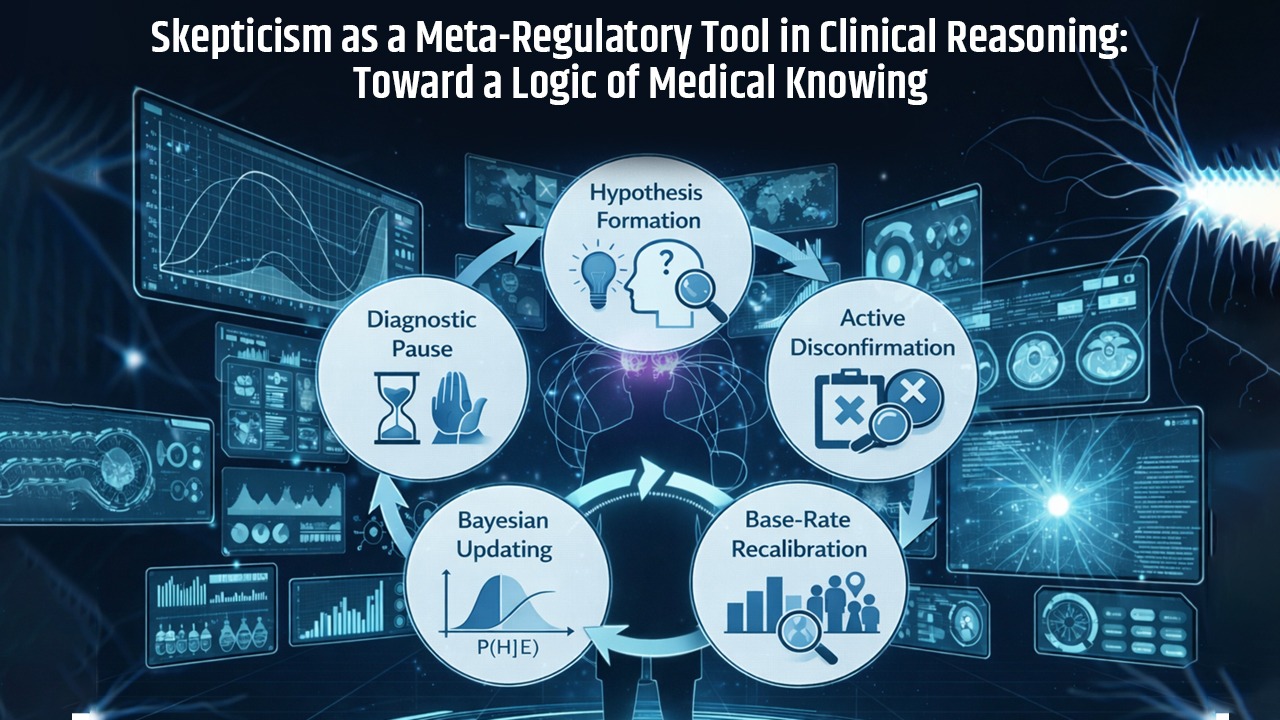
11. Diagnosis as Asymptotic Inquiry: The Cycle
The term asymptotic — approaching a limiting value ever more closely without fully reaching it — describes the epistemic structure of clinical diagnosis with precision. Each iteration of the inquiry cycle brings the working hypothesis closer to the underlying pathological reality. No single iteration makes that reality fully transparent; each one, including those that require revision, reduces the distance between the working hypothesis and the truth.
The most important conceptual reorientation this essay proposes is the reconceptualisation of clinical action as a moment of inquiry rather than its termination. In the standard picture of diagnosis, action follows the diagnostic process. In the picture proposed here, action is part of the diagnostic process: it generates new phenomenal evidence, in the form of the patient’s response, that feeds back into the cycle of abductive inference and revision.
This picture has a precise philosophical grounding in Peirce’s account of abductive reasoning and Dewey’s account of reflective action. For Peirce, abductive inference — the inference from a set of surprising observations to the hypothesis that would, if true, render them unsurprising — is not a one-time event but a continuously self-correcting process. The hypothesis generated by abduction is a guide to further inquiry, and further inquiry generates new observations that either confirm, weaken, or overturn the hypothesis. For Dewey, similarly, reflective thinking does not precede action but is enacted through action: to act on a hypothesis in a problematic situation is to put the hypothesis to the test, and the situation’s response to the action is the form that test takes. The clinician who administers empirical antibiotics and then monitors the patient’s haemodynamic trajectory is not acting first and thinking later; they are thinking through action.
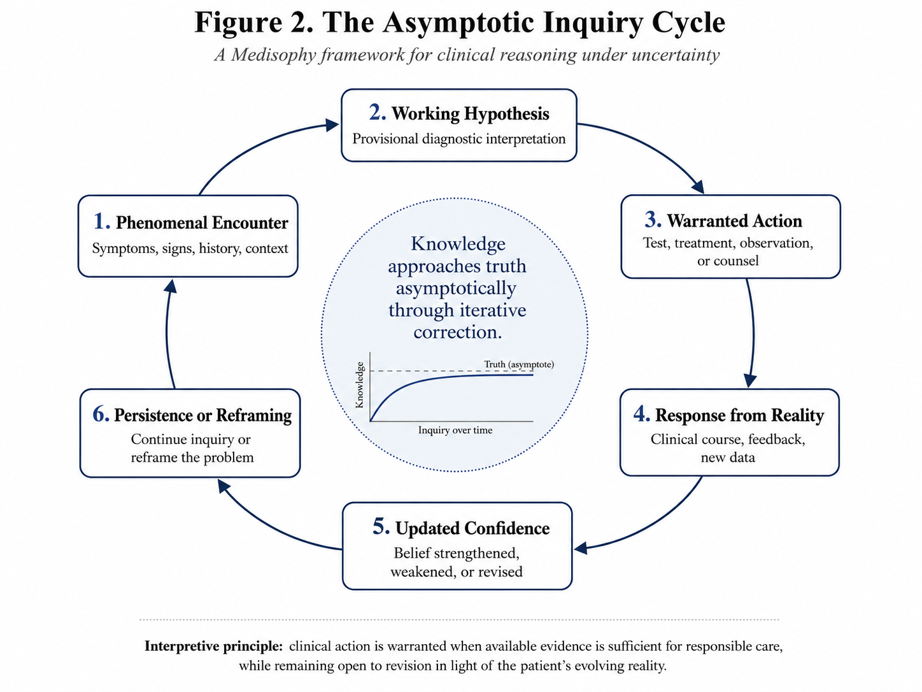
The cycle makes visible several features of clinical reasoning that the linear sequence obscures. Action is positioned not at the end of the cycle but in the middle: it follows from the abductive working hypothesis and is followed by the response of reality — the ‘back-talk’ of the patient’s clinical course. That response becomes new phenomenal evidence; confidence is updated; and the clinician either persists with the working hypothesis, revises it partially, or reframes the entire diagnostic situation. The cycle then begins again.
The patient answers back. The fever that fails to resolve on antibiotics, the hypotension that is disproportionate to the volume given, the rash that transforms from maculopapular to petechial overnight: these are not inconveniences that disturb the diagnostic conclusion. They are the next layer of phenomenal evidence, and they are the mechanism by which clinical inquiry asymptotically approaches truth.
The naïve realist exits the cycle prematurely: the first diagnostic frame is constituted as fact, and subsequent back-talk is reinterpreted to fit it rather than allowed to challenge it. The paralytic never enters the cycle effectively: without action, the back-talk that would provide the next layer of evidence is never generated. The phronimos runs the cycle deliberately, explicitly, and with a mind designed to receive disconfirmatory evidence as information rather than threat.
12. The Physician as Phronimos: Practical Wisdom and the Singular Case
The Aristotelian concept of phronesis — practical wisdom, the virtue of excellent judgment in contingent and singular situations — is the philosophical concept most adequate to what the preceding analysis describes. Phronesis is not the application of universal rules to particular cases; Aristotle is explicit that the particular case always exceeds what any rule can fully specify. Phronesis is the capacity to perceive the morally and practically salient features of the particular situation, to weigh incommensurable considerations without a superordinate algorithm, and to act in a way that is excellent relative to the full complexity of what the situation demands.
The clinical situation has exactly this structure. Guidelines specify what is generally indicated for a given diagnostic category; they cannot specify what is indicated for this particular patient, at this moment in the evolution of this particular illness, with this particular comorbidity profile, in this particular social and institutional context. The move from the general indication to the particular clinical action requires precisely the kind of judgment that Aristotle calls phronesis and that clinical education rarely teaches explicitly.
Phronesis, for Aristotle, is a virtue in the full technical sense: a stable disposition toward excellent performance that is acquired through habituation and experience, not through the transmission of propositions. This is the philosophical basis for the irreplaceability of clinical apprenticeship. One does not learn phronesis by reading about it. One acquires it through the repeated, supervised encounter with the particular case in all its irreducible complexity, guided by a more experienced practitioner who embodies the virtue and makes its exercise visible. The apprentice who watches a senior clinician think aloud at the bedside — explicitly narrating uncertainty, prospectively naming the disconfirmatory findings they are monitoring for, and demonstrating that revision is not humiliation but integrity — is not merely acquiring information. They are witnessing phronesis in action, and that witnessing is the developmental mechanism through which the virtue is gradually appropriated.
The physician is not merely a technician applying protocols to diagnoses. The physician is a practical philosopher of the singular case: the person whose task it is to determine, in full awareness of the phenomenal/noumenal gap, what responsible action looks like for this particular human being, in this particular moment of their illness, under conditions that no guideline can fully specify and no algorithm can adequately replace.
13. The Development of Epistemic Courage: A Developmental Model
Epistemic courage is not transmitted by instruction. It is not acquired by reading a philosophical account of its structure, however precise. It is a virtue, and virtues are formed through the habituation of experience under appropriate conditions – conditions that clinical education can deliberately design if it understands the developmental trajectory through which the virtue is acquired.
| Stage | Characteristic Experience | Risk If Unsupported | Educational Requirement |
| 1 – Epistemic Innocence | Pattern matching without awareness of what the pattern excludes or distorts | False simplicity; diagnostic overconfidence without the cognitive architecture to recognise it | Structured clinical exposure; illness script formation; comparison of textbook and real presentations |
| 2 – Epistemic Anxiety | Acute awareness of how much can be wrong; first encounter with genuine diagnostic error | Paralysis; the insight that certainty is unavailable read as an injunction against action | Supervised warranted action; explicit threshold teaching; narrated expert modelling; developmental reassurance |
| 3 – Epistemic Proceduralism | Managed uncertainty through explicit checklists, differentials, probability language, and safety-netting | Checklist rigidity; failure when cases exceed procedural templates; mechanical rather than dispositional reasoning | Atypical case exposure; calibration feedback; case complexity beyond procedural coverage; reflection-in-action training |
| 4 – Epistemic Courage | Dispositional capacity to act without certainty; revise without shame; communicate uncertainty honestly | Unsupported extension into excessive complexity; requires continued mentorship at the frontier | Reflective mastery; advanced case complexity; peer consultation culture; deliberate practice at the edge |
Table 2. The four developmental stages of epistemic courage. Each stage has a characteristic epistemic experience, a risk if the transition is unsupported, and a corresponding educational requirement.
Stage Three proceduralism has a characteristic failure mode: the trainee who has learned to work through a dyspnoea checklist – cardiac, pulmonary, metabolic, haematological – may be unable to respond when a patient presents with a pattern that cuts across the categories, because no procedural rule specifies what to do when the template does not fit the case. The procedures were designed for typical presentations. Atypical presentations reveal whether the clinician has internalised a disposition or merely a procedure.
The most important pedagogical insight embedded in this model is the reconceptualisation of Stage Two. Epistemic Anxiety is almost universally treated by clinical supervisors as a problem to be corrected — a deficiency of confidence that requires reassurance, encouragement, or the provision of simpler cases. This is the wrong response. Epistemic Anxiety is not a deficiency but a passage: it is the developmental moment at which the trainee’s epistemic innocence has been disrupted by genuine engagement with the complexity of clinical reality, and the trainee has not yet developed the cognitive and attitudinal resources to act within that complexity.
The anxiety is not merely appropriate; it is necessary. A clinician who never passed through Stage Two — who moved directly from Epistemic Innocence to Epistemic Proceduralism without genuinely confronting the depth of diagnostic uncertainty — has not formed the virtue of epistemic courage. They have acquired the procedures that manage uncertainty without the dispositional orientation that makes those procedures generative rather than mechanical. When a case exceeds their procedural templates, they lack the resources to respond with genuine phronesis. Supporting trainees through Stage Two, rather than around it, is the most important single intervention available to clinical educators.
The transition from Stage Three to Stage Four — from Epistemic Proceduralism to Epistemic Courage — requires something specific that clinical education rarely designs explicitly: the encounter with a case that the procedures cannot handle, witnessed in the presence of a Stage Four practitioner who models the dispositional response. The trainee must see what it looks like to encounter genuine diagnostic complexity without a procedural template, and to respond with the kind of confident, humble, revisable judgment that constitutes epistemic courage. This is a teachable moment. Current curricula do not reliably create it.
The developmental model has a direct implication for bedside teaching. The kind of narration that is productive depends on where the trainee currently stands. A Stage One trainee benefits from explicit naming of the working hypothesis and its evidential basis. A Stage Two trainee needs to hear, above all, that acting under uncertainty is not only permissible but required. A Stage Three trainee needs to see a senior clinician respond to a case that exceeds the procedural template — and to observe that the response is not paralysis but confident, revisable judgment. The narrated expert is, in each case, modelling the next developmental stage.
14. Teaching Epistemic Courage at the Bedside: The Narrated Expert
The most powerful pedagogical tool available to the clinical teacher is not a lecture, a simulation, or a curriculum document. It is the narrated thinking of a senior clinician who genuinely possesses epistemic courage, made audible to the trainee in real time, in the presence of the actual patient. This is what the apprenticeship model, at its best, has always provided. What the Medisophy analysis adds is a precise account of what must be narrated, and why.
The narration must be genuinely two-level. It must include the first-order clinical reasoning — the hypothesis, the action, the monitoring plan — and it must include the second-order epistemic orientation: the degree of confidence with which the hypothesis is held, the alternative hypotheses that remain live, and the specific findings that would compel revision. The trainee who hears only the first-order narration learns that the senior clinician acts decisively. The trainee who hears both learns that the senior clinician acts decisively while doubting intelligently: that confidence and provisionality are not opposites but simultaneous features of mature clinical reasoning.
The invisible cognition of the expert must become audible to the learner. Not only: “I think this is septic shock, so I am starting antibiotics.” But: “Septic shock is my leading hypothesis, held with moderate confidence, because the clinical picture fits well but not perfectly. I am acting now because delay is dangerous and my uncertainty does not affect the appropriateness of empirical treatment. I am specifically watching for the key findings that would make me reconsider the diagnosis. If the patient does not respond as I expect within four hours, I am committing to a formal diagnostic review.”
This narration is not performed for the trainee’s benefit alone. It is the authentic expression of what mature clinical reasoning actually is. The senior clinician who narrates in this way is not simplifying their thinking for a pedagogical audience; they are making explicit the reasoning that good clinical practice embodies in every case. The fact that this narration is pedagogically productive is a consequence of its clinical authenticity.
| Q | The Question | What It Assesses |
| 1 | What is your working diagnosis, and on what evidence? | Abductive reasoning; illness script formation; phenomenal synthesis |
| 2 | How confident are you, and why at that level? | Probability calibration; awareness of evidential weight and its limits |
| 3 | What alternative diagnoses remain clinically alive? | Differential breadth; resistance to premature closure; constitutive vs regulative holding |
| 4 | What action is warranted now, and why? | Threshold reasoning; risk-benefit integration; decisiveness under uncertainty |
| 5 | What specific findings would compel you to revise the hypothesis? | Revisability; prospective disconfirmation design; epistemic openness |
| 6 | When and how precisely will you reassess? | Inquiry continuity; temporal structuring of uncertainty; commitment to feedback |
Table 3. A six-question assessment rubric for warranted provisional action. Assesses the quality of clinical reasoning rather than the correctness of diagnostic outcome.
15. The Language of Epistemic Courage at the Bedside
Clinical language is not neutral with respect to clinical reasoning. The words a physician chooses to describe a diagnosis to a patient, to a colleague, or in a clinical note shape the cognitive frame within which subsequent information is received and interpreted. Language that forecloses too early – that names the diagnosis as if it were direct access to noumenal reality – makes subsequent revision psychologically more costly and cognitively more difficult. Language that structures uncertainty explicitly makes revision a natural continuation of a process already openly acknowledged.
| Clinical Situation | Language of Premature Closure – Avoid | Language of Warranted Provisional Action – Use |
| Septic shock | This is definitely sepsis. | Septic shock is my leading working hypothesis. The probability and risk of delay justify immediate intervention; I am simultaneously monitoring for evidence that would require reframing. |
| Fever with rash | Probably viral. Nothing serious. | Viral exanthem is possible, but the trajectory, warning signs, haemodynamic status, drug exposure, and systemic inflammatory markers will determine whether the frame requires revision. |
| Normal investigations | Reports are normal; we can close the case. | Available investigations reduce the probability of certain diagnoses but do not eliminate all serious possibilities. The clinical trajectory over the next interval remains diagnostically informative. |
| Diagnostic uncertainty | I don’t know, so let us wait. | Complete diagnostic clarity is not yet available. The safest and most reasonable next step, given current evidence, is this action. Reassessment is planned for this interval. |
| Diagnostic revision | I was wrong. | The initial working hypothesis was warranted on the evidence available at the time. New phenomenal evidence now requires revision. This is the cycle working as designed. |
Table 4. Contrasting clinical language. The left column represents language of premature closure; the right column represents language of warranted provisional action. The difference is not cosmetic; it shapes the clinician’s cognitive relationship to subsequent evidence.
The clinical language of warranted provisional action is not the language of helplessness or diagnostic indecision. It is the language of honesty about a situation that is genuinely complex, combined with a confident statement of what the evidence currently warrants. It communicates to the patient, to the team, and to the clinician themselves that the case is being held in an epistemically responsible way: that the physician has formed a view, is acting on it, and is designed to revise it if reality requires.
Epistemic honesty in clinical language is not a risk communication strategy. It is an expression of the physician’s actual relationship to knowledge — and that relationship, made explicit in language, shapes both clinical cognition and the culture of the team.
16. Revision Is Not Failure: The Ethics of Diagnostic Honesty
One of the deepest sources of naïve realism in clinical practice is not cognitive but moral: the belief that revising a diagnosis is an admission of error, and that admissions of error are professionally dangerous. This belief is widespread, frequently implicit, and pedagogically transmitted through the clinical culture that surrounds trainees far more powerfully than any explicit instruction. It is also philosophically incoherent and clinically harmful.
If the Medisophy analysis is correct — if all diagnostic conclusions are phenomenally grounded approximations that tend asymptotically toward but never finally reach the noumenal reality they concern — then revision is not evidence of previous error. Revision is evidence that the clinical inquiry is functioning correctly: that new phenomenal evidence has been received, registered, and appropriately incorporated into a progressively more adequate hypothesis. To resist revision is not to protect the integrity of the original conclusion; it is to cut off the inquiry that would improve it.
The physician who says, “I was wrong” is making a statement about an ontological situation — the disease as it actually exists — as if they had previously accessed it and incorrectly reported it. But this is precisely what the physician could not do. The physician had previously formed the best available inference from the phenomenal evidence at hand. If new evidence now warrants a different inference, the change is not a correction of an error; it is the next step in a self-correcting inquiry.
The diagnosis belongs to the patient’s evolving biological reality, not to the physician’s professional ego. The physician is not the owner of the diagnosis. The physician is the custodian of the best current approximation to an underlying reality that may yet require a better account. Revision is not humiliation. It is fidelity — to the patient, to the process of inquiry, and to the epistemic values that medicine, at its best, embodies.
17. Against Retrospective Certainty: The Prospective Standard of Clinical Judgment
Clinical decisions are made prospectively, within the epistemic conditions that exist at the moment of decision. They are judged retrospectively, from a vantage point at which the outcome is known and the diagnostic answer is apparent. The systematic difference between these two epistemic positions creates a form of injustice that clinical culture, medical audit, and legal reasoning all tend to perpetuate without adequately acknowledging.
What Fischhoff called the hindsight bias operates powerfully in clinical judgment: once the outcome is known, the previously available evidence is reconstructed in memory as more diagnostic than it was perceived to be at the time. The elevated troponin that was thought to represent demand ischaemia now looks unambiguously like NSTEMI; the low-grade fever on day three that was attributed to the inflammatory response of surgery now looks obviously like the herald of wound sepsis. These reconstructions are cognitively automatic and subjectively experienced as accurate — making the earlier clinical conclusion appear not merely unlucky but genuinely negligent.
The philosophical corrective to this injustice is the insistence on what may be called the prospective epistemic standard: clinical judgment must be evaluated in terms of the epistemic conditions that existed at the time of the decision, not in terms of the subsequently available knowledge. The question is not: given what we now know, was this the right decision? The question is: given what was knowable at the time, in the time available, with the clinical resources accessible, was this a responsible and warranted inference from the available phenomenal evidence?
Consider the standard morbidity and mortality meeting. A patient presented with fever and tachycardia; the working diagnosis was infection; a troponin that returned twelve hours later revealed a type 2 myocardial infarction driven by sepsis-related demand ischaemia. In retrospect the cardiac diagnosis appears obvious. But at the time of presentation, with a temperature of 39°C, productive cough, and no chest pain, the working diagnosis was not only reasonable — it was the most warranted inference from the available phenomenal evidence. The M&M meeting that judges this case by the standard of retrospective certainty does not improve clinical practice. It teaches clinicians to document defensively and to project confidence they do not possess.
A bad outcome does not establish a bad decision. A revised diagnosis does not establish a mistaken earlier conclusion. A good decision, made under warranted uncertainty, with appropriate second-order epistemic orientation, is a good decision regardless of what subsequently transpires. Clinical culture, medical education, and the systems of institutional accountability that govern clinical practice must internalise this distinction if they are to assess clinical reasoning fairly, to educate clinicians honestly, and to create the conditions in which epistemic courage is rewarded rather than punished.
18. Clinical Humility Is Not Diffidence: Reclaiming the Virtue
The argument of this essay may appear to risk undermining clinical confidence by insisting on the provisionality of all diagnostic conclusions. This is the opposite of what is intended. The concept of epistemic courage that the essay develops is precisely the capacity to act with confidence under acknowledged uncertainty — not confidence that certainty has been achieved, but confidence that the available evidence warrants the action taken and that the clinician has the resources to revise if revision is required.
This is a more demanding standard of confidence than the naïve realism it displaces, not a less demanding one. The naïve realist’s confidence is cheap: it requires no ongoing engagement with disconfirmatory evidence, no explicit design of monitoring plans, no prospective definition of revision triggers, no cognitive discipline of second-order epistemic orientation. The phronimos’s confidence is expensive: it requires all of these things, simultaneously, while also acting decisively on the first-order register.
Clinical humility, properly understood, is not the diffidence of the uncertain or the hesitation of the uninformed. It is the disciplined acknowledgment, by a clinician who is acting with full engagement and genuine expertise, that their best current inference remains an inference — a phenomenally grounded approximation to a noumenal reality that may yet require a more adequate account. This acknowledgment does not weaken the action it accompanies. It makes the action more honest, more trustworthy, more morally serious, and more clinically effective.
The opposite of clinical humility is not confidence. The opposite of clinical humility is epistemic closure — the premature constitutive fixing of what must remain a regulative hypothesis. Sometimes the clinician who hesitates is not humble but frightened: uncertainty misread as an injunction against action, philosophy misapplied as an excuse for the avoidance of responsibility. The virtue of epistemic courage requires the capacity to distinguish genuine epistemic openness from the disguise that paralysis wears when it calls itself caution.
19. The Clinical Culture of Epistemic Courage: Institutional Implications
No individual formation program can produce clinicians who practise warranted provisional action if the institutional culture in which they practise systematically punishes its expression. The hidden curriculum of clinical education — the implicit messages transmitted by the culture of rounds, audit, morbidity review, and institutional accountability — is more powerful than any explicit instruction. If that hidden curriculum rewards confident-sounding answers over epistemically honest ones, treats revised diagnoses as evidence of initial incompetence, and associates visible uncertainty with weakness, it will systematically select for the naïve realist profile and inhibit the development of epistemic courage regardless of what is taught in lecture theatres.
The institutional conditions for epistemic courage are specific and can be deliberately created. Morbidity review processes should ask not only whether the final diagnosis was reached but whether the initial hypothesis was warranted, whether alternatives were kept alive, whether monitoring plans were designed to detect disconfirmation, and whether revision occurred promptly when new evidence warranted it. Assessment rubrics should evaluate reasoning quality explicitly and independently of diagnostic accuracy. Senior clinicians in positions of supervisory authority should model second-order epistemic narration in their own clinical communication, creating a professional norm in which the expression of calibrated uncertainty is a sign of clinical maturity rather than a confession of deficiency.
A clinical culture that rewards epistemic courage will be safer, more honest, more resilient to diagnostic error, and more capable of learning from its mistakes than one that rewards apparent certainty. The creation of that culture is not the responsibility of individual clinicians alone. It is an institutional and professional obligation.
The formation of such a culture becomes not less but more urgent as the technological environment of medicine grows more complex. The question of what clinical education must cultivate is therefore not merely a matter of pedagogical preference. It is a professional imperative for a discipline whose practitioners will be asked to exercise judgment in conditions of ever-increasing informational complexity.
20. Conclusion: Medicine at the Boundary of the Knowable
The future of medicine will deliver more data, more algorithmic support, more genomic precision, more continuous physiological monitoring, and more artificial intelligence capable of pattern recognition at scales and speeds that exceed human cognitive capacity. None of this will abolish the uncertainty that the Medisophy framework describes. The noumenal disease will remain, in principle, beyond the reach of any finite knowing subject, however well equipped. What the future clinician must possess is not more information than machines can process, but the judgment to interpret incomplete, conflicting, and morally charged information in the presence of a suffering human being whose situation no algorithm has yet encountered in exactly the form it presents today.
That judgment — phronesis applied to the phenomenal conditions of clinical practice — is the highest intellectual virtue that medicine can aspire to cultivate. Its formation is the deepest purpose of clinical education. Its expression is warranted provisional action: the decisive, humble, revisable, and epistemically honest response of a mature physician to the irreducible uncertainty that medicine, at the boundary of the humanly knowable, always involves.
The good clinician does not say: I am certain, therefore I act. That is the naïve realist, whose confidence is real but whose humility is absent. Nor does the good clinician say: I am uncertain, therefore I wait. That is the paralytic, whose humility is real but whose courage is absent. The mature clinician says: the noumenon of this disease exceeds my grasp, as it always will. The phenomenal evidence before me is sufficient to warrant action now. I will act, monitor the patient’s evolving reality as the next layer of evidence, and revise without shame when that reality demands a better account.
That is warranted provisional action. That is epistemic courage. That is medicine as Medisophy understands it: not the confident possession of truth, but the disciplined, humble, and courageous pursuit of it — on behalf of a patient who cannot wait, in a situation that cannot be fully specified, under conditions that never quite resolve, at the boundary where the knowable meets what cannot yet be known.
The boundary between the knowable and the not-yet-known is not a defect in medicine. It is where medicine happens — and it is where the physician who possesses epistemic courage is most needed.
Core Aphorisms
A diagnosis is not a possession. It is a responsibility held on behalf of a patient whose biological reality may yet require a better account.
Epistemic humility is not the absence of confidence. It is the refusal to mistake the phenomenon for the noumenon, the map for the territory, the inference for the thing itself.
Uncertainty does not justify inaction. It demands a particular kind of action: warranted, monitored, and designed in advance for the possibility of revision.
Humility lives in how the diagnosis is held. Courage lives in what is done with it. Clinical wisdom is the capacity to exercise both in the same moment.
A wrong diagnosis held lightly may be corrected. A wrong diagnosis held constitutively becomes a harm that compounds with every piece of contradictory evidence ignored.
The good physician acts before certainty, monitors after action, and revises without shame when the patient’s evolving reality demands it.
Medicine does not begin when certainty arrives. Medicine begins where certainty never fully arrives, and responsible action is demanded nonetheless.
The boundary between the knowable and the unknown is not a defect in medicine. It is where medicine happens, and it is where the physician must learn to stand.
References
Aristotle. Nicomachean Ethics. Translated by Irwin T. Indianapolis: Hackett Publishing; 1999.
Croskerry P. Achieving quality in clinical decision making: cognitive strategies and detection of bias. Acad Emerg Med. 2002;9(11):1184–1204.
Dewey J. How We Think: A Restatement of the Relation of Reflective Thinking to the Educative Process. Boston: D.C. Heath; 1910.
Dewey J. Experience and Education. New York: Kappa Delta Pi; 1938.
Dreyfus HL, Dreyfus SE. Mind over Machine: The Power of Human Intuition and Expertise in the Era of the Computer. New York: Free Press; 1986.
Fischhoff B. Hindsight does not equal foresight: the effect of outcome knowledge on judgment under uncertainty. J Exp Psychol Hum Percept Perform. 1975;1(3):288–299.
Fricker M. Epistemic Injustice: Power and the Ethics of Knowing. Oxford: Oxford University Press; 2007.
Graber ML, Franklin N, Gordon R. Diagnostic error in internal medicine. Arch Intern Med. 2005;165(13):1493–1499.
Ilgen JS, Regehr G, Teunissen PW. Tolerance for ambiguity: a core competency for clinical training. Med Educ. 2016;50(6):613–622.
Kant I. Critique of Pure Reason [1781]. Translated by Kemp Smith N. London: Palgrave Macmillan; 1929.
Kant I. Critique of Practical Reason [1788]. Translated by Gregor M. Cambridge: Cambridge University Press; 1997.
Montgomery K. How Doctors Think: Clinical Judgment and the Practice of Medicine. Oxford: Oxford University Press; 2006.
Pauker SG, Kassirer JP. The threshold approach to clinical decision making. N Engl J Med. 1980;302(20):1109–1117.
Peirce CS. Abduction and induction. In: Buchler J, ed. Philosophical Writings of Peirce. New York: Dover Publications; 1955:150–156.
Pellegrino ED, Thomasma DC. A Philosophical Basis of Medical Practice. New York: Oxford University Press; 1981.
Schön DA. The Reflective Practitioner: How Professionals Think in Action. New York: Basic Books; 1983.
Schön DA. Educating the Reflective Practitioner. San Francisco: Jossey-Bass; 1987.
Shinde AG. Diagnosis at the Edge of Knowledge: A Kantian Account of Clinical Reasoning in the Light of Medisophy. Thinking Healer. 2026. Available at: https://thinkinghealer.com/medisophy/diagnosis-edge-of-knowledge/
Vygotsky LS. Mind in Society: The Development of Higher Psychological Processes. Cambridge: Harvard University Press; 1978.







Leave a Reply